Atomic Structure: Protons, Neutrons and Electrons
Atomic structure is the arrangement of protons, neutrons and electrons in an atom. The particles, their charges and masses, and how the nucleus was discovered.
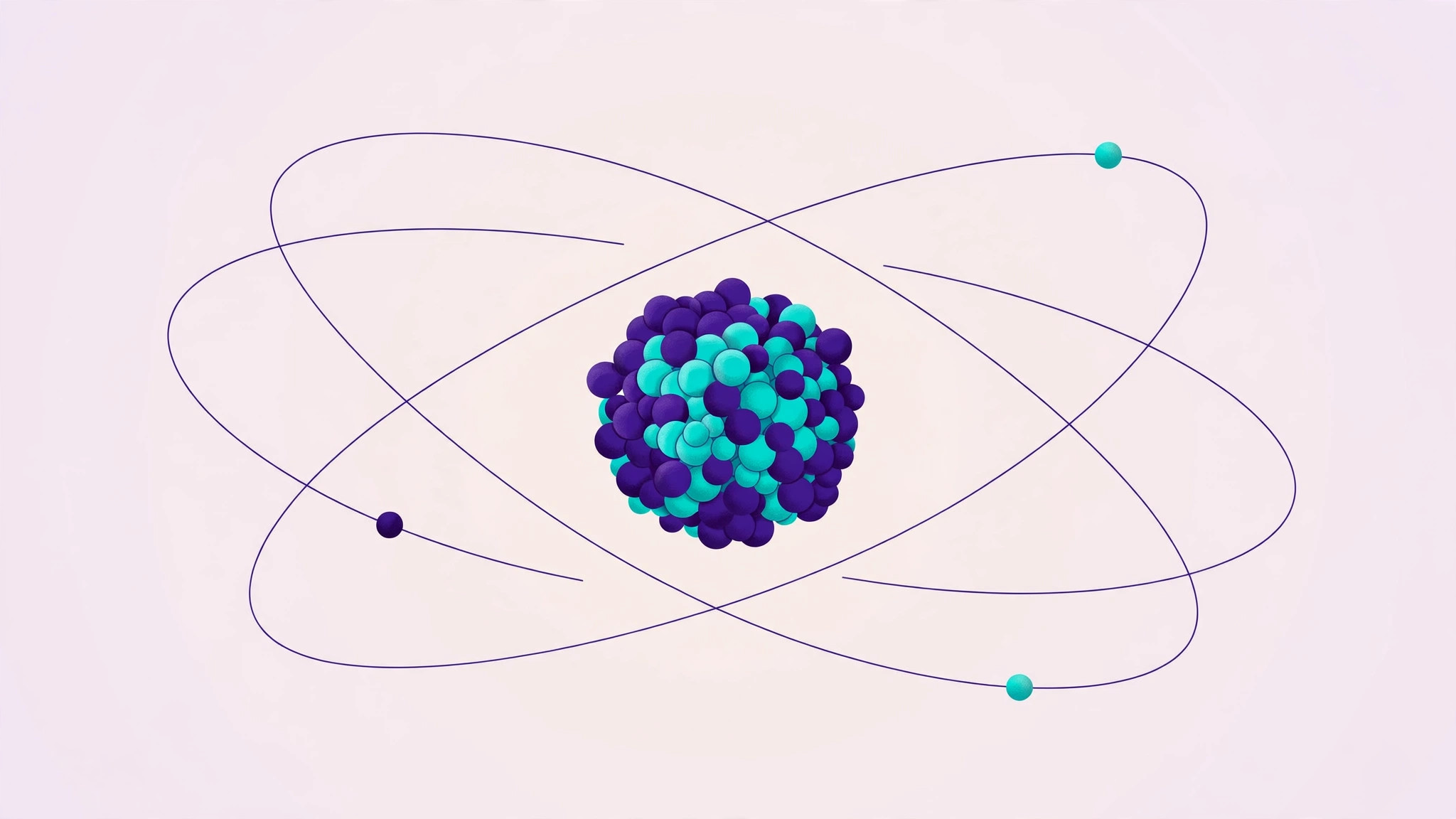
Three particles build everything
An atom is a tiny dense nucleus of protons and neutrons, carrying nearly all the mass, surrounded by electrons in shells. The proton and neutron each weigh about one atomic mass unit; the electron weighs about one eighteen hundredth of that, nearly negligible in mass but decisive in chemistry, because electrons are what atoms exchange and share. Protons carry positive charge, electrons an equal negative charge, and neutrons none. A neutral atom balances protons and electrons exactly, and the proton count, the atomic number, is the element's identity card: change it and you have a different element, which is the one transformation ordinary chemistry can never perform.
How the picture was earned
The nuclear atom was not obvious. Thomson's discovery of the electron in 1897 made atoms divisible; Rutherford's scattering experiment in 1911, in which a few alpha particles bounced back from gold foil as if hitting something hard and small, revealed the concentrated nucleus; Bohr and then quantum mechanics arranged the electrons into shells and orbitals of definite energy. Each model explained the failures of the one before, and the shell picture, two electrons in the first shell, eight in the second and third for the elements of school chemistry, remains the working model for predicting bonding and the periodic table's shape.
Scale and consequence
The nucleus occupies about a trillionth of the atom's volume: scale an atom to a stadium and the nucleus is a marble at its centre, with the electrons a faint presence in the stands. Matter is therefore mostly empty space, held solid by electromagnetic forces, a fact that takes some absorbing. The arrangement explains the rest of this site: molar masses come from the nucleus's particle count, bonding from the outer electrons, isotopes from varying neutrons, and ions from electrons gained or lost. Atomic structure is not one topic among many; it is the foundation under every calculation and guide here, which is why it rewards being learned first and learned well. The numbers deserve one concrete picture. A typical atom is about a tenth of a nanometre across, ten million of them would span a millimetre, and the electrons that decide its chemistry occupy that whole span while the nucleus occupies a millionth of the width. If the nucleus were a marble one centimetre wide, the atom would be a sphere a hundred metres across and the electrons would be specks somewhere inside it. Yet the marble outweighs the specks five thousand to one per particle. Chemistry happens in the wide empty outskirts; mass, identity and radioactivity live in the tiny centre, and holding both facts at once is the beginning of thinking like a chemist.
Try it yourself
The calculator that goes with this guide is ready on the tools page.
Build amounts from atoms