Atoms, Molecules and Ions: Three Kinds of Particle
Atoms, molecules and ions are the three kinds of particle chemistry counts. How they differ, and why the distinction decides how substances behave.
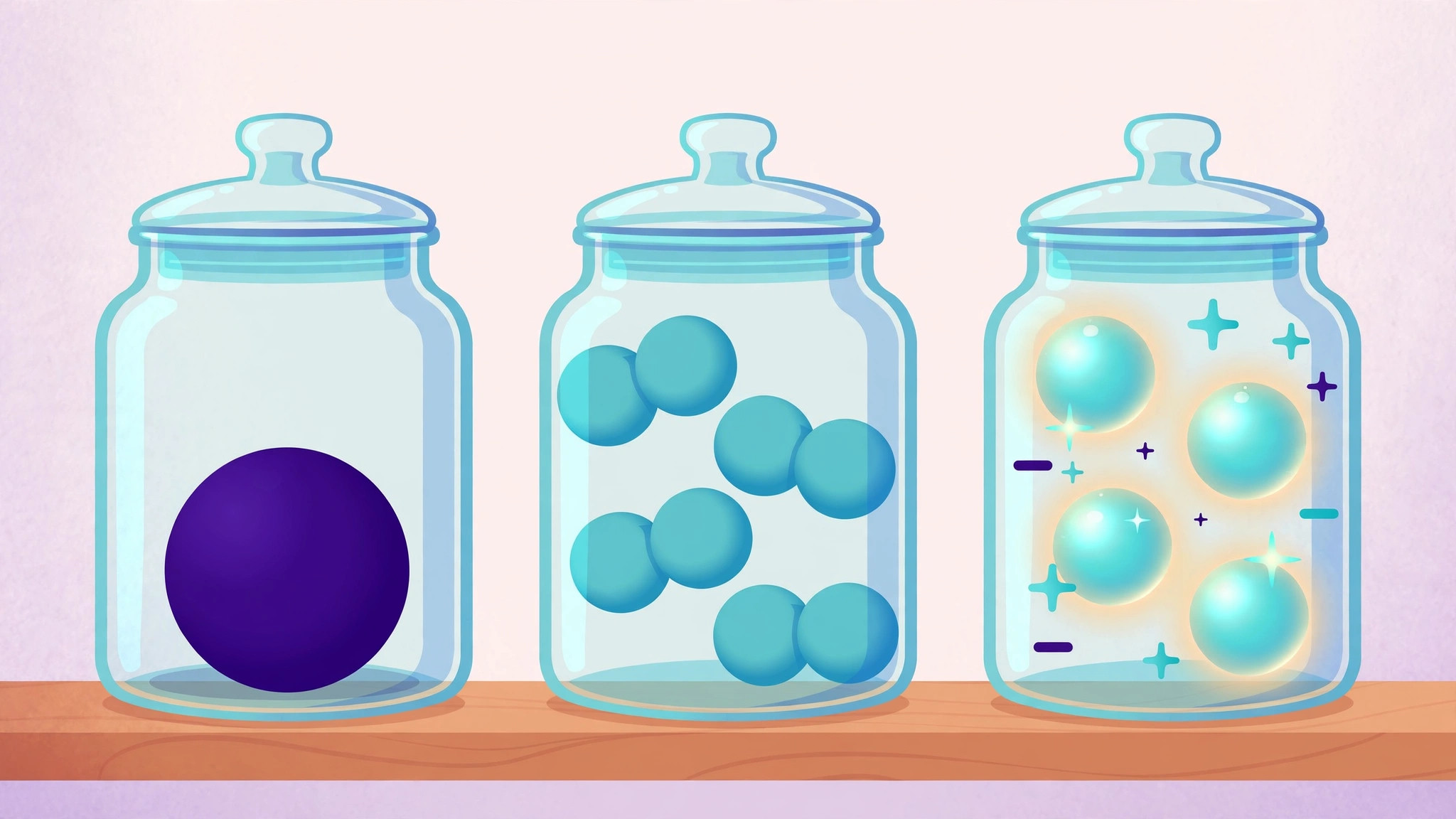
Three kinds of particle
An atom is a single particle of an element: one iron atom, one oxygen atom. A molecule is two or more atoms joined together, whether of the same element, like the O2 molecules in the air, or of different elements, like water, H2O. An ion is an atom or group of atoms carrying an electric charge, formed when electrons are gained or lost: the sodium ion Na+ has one fewer electron than the sodium atom, and the chloride ion Cl- has one more. The three words are not interchangeable, and using the right one is the first step in describing any substance correctly.
Charge changes everything
An ion behaves almost nothing like its parent atom. Sodium atoms are soft metals that burst into flame in water; sodium ions are a harmless part of table salt and of your own blood. Chlorine gas is a poisonous green weapon of war; chloride ions season food. The change of one electron rewrites the chemistry completely, because reactions are transactions in electrons. This is also why ionic compounds conduct electricity when molten or dissolved: the ions, locked in place in the solid, become free to move and carry charge, while the neutral atoms of a metal conduct by a different mechanism entirely.
Counting particles correctly
Calculations depend on naming the particle. A mole of sodium chloride contains a mole of sodium ions and a mole of chloride ions, two moles of particles in all, which matters for properties like freezing point depression that count dissolved particles. A mole of oxygen gas contains a mole of O2 molecules but two moles of oxygen atoms. When a problem asks how many atoms are present, the subscripts inside the formula do the multiplying, and when it asks about ions in a solution, the formula of the salt splits into its ions. The amount converter on the tools page counts particles in moles; keeping straight which particle you mean is your contribution to the answer. The vocabulary pays off most visibly in electrolysis and solution work. When sodium chloride solution is electrolysed, it is chloride ions that travel to one electrode and sodium ions, with hydrogen ions from the water, that feature at the other; speaking of chlorine molecules or sodium atoms in that solution would describe substances that are simply not there. Examination questions test this precision deliberately, asking for the particles present in a solution or a melt. A reliable habit is to picture the substance before naming its particles: lattice, molecules or separated ions, and let the picture choose the word.
Try it yourself
The calculator that goes with this guide is ready on the tools page.
Count particles with the converter