Chemical Equilibrium and Le Chatelier's Principle
Chemical equilibrium is a balance of two reactions running at once, not a stop. Le Chatelier's principle predicts how the balance shifts when conditions change.
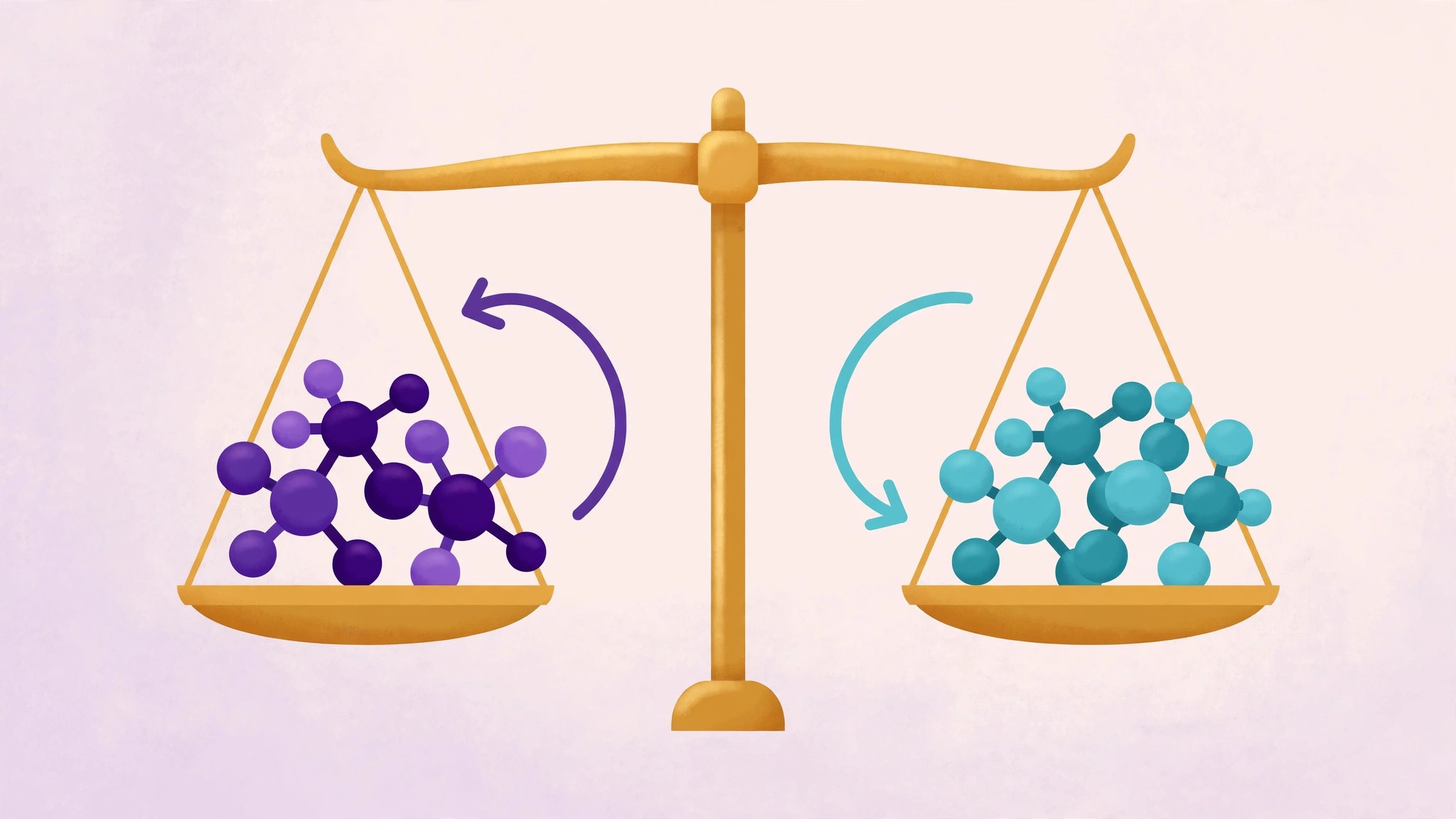
A balance that never sleeps
Many reactions do not run to completion. Instead they reach equilibrium, a state where the forward reaction and the reverse reaction run at equal rates, so the amounts of everything stop changing although the reactions themselves never stop. It is a dynamic balance, like a shop whose stock stays level because deliveries match sales, not because trading ceased. The position of equilibrium, how far toward products the balance sits, is fixed at a given temperature and described by an equilibrium constant. A large constant means the products dominate; a small one means the reactants barely reacted at all.
Le Chatelier's principle
When a system at equilibrium is disturbed, it responds in the direction that partly cancels the disturbance. Add more reactant and the balance shifts toward products to consume some of it. Raise the pressure on a gas equilibrium and it shifts toward the side with fewer gas molecules, reducing the pressure again. Heat an equilibrium and it shifts in the endothermic direction, absorbing the added heat. The principle, stated by Le Chatelier in the 1880s, predicts all three responses from one idea: the system pushes back. Catalysts are the exception worth memorising; they speed both directions equally and change how fast equilibrium arrives, never where it sits.
Industry tuned by equilibrium
The Haber process, making ammonia from nitrogen and hydrogen, is the classic negotiation with equilibrium. The reaction is exothermic, so low temperatures favour a high yield, but low temperatures are unacceptably slow, and the process settles on a compromise near 450 degrees with high pressure, which favours the side with fewer molecules, and an iron catalyst, recycling the unreacted gases round again. Every choice in the plant is Le Chatelier's principle wearing overalls. Understanding equilibrium turns a list of industrial conditions from facts to memorise into consequences that can be reasoned out, which is precisely why examiners and engineers both love the topic. The idea reaches beyond the laboratory into the body and the environment. The binding of oxygen to haemoglobin is an equilibrium, shifted toward release in the tissues where carbon dioxide makes the blood slightly more acidic, a coupling of two equilibria that delivers oxygen exactly where it is being spent. The oceans absorb carbon dioxide into a carbonate equilibrium that buffers the water but slowly acidifies it as more gas dissolves, with consequences for shell building creatures. Equilibrium is not a chapter of chemistry that ends with the examination; it is the operating condition of most real systems, which sit not at completion but at a managed balance.
Try it yourself
The calculator that goes with this guide is ready on the tools page.
See yields in the reaction tools