Density Explained: Mass Packed Into Volume
Density is mass divided by volume, a property that identifies substances, predicts floating and sinking, and links to the molar mass of gases.
How much mass in how much space
Density packs two measurements into one property: divide the mass of a sample by its volume. Water sits near 1.00 grams per millilitre, aluminium at 2.70 grams per cubic centimetre, and lead at 11.3, which is why a lead block feels startlingly heavy for its size. Density is an intensive property, meaning it does not depend on how much material you have: a drop of water and a lake of it share the same density at the same temperature. That independence is what makes density useful for identifying substances, because a measured density can be matched against tables like a fingerprint.
Measuring and calculating
For a regular solid, volume comes from its dimensions; for an irregular one, from the water it displaces in a measuring cylinder, a method credited to Archimedes and his famous bath. Liquids are weighed in a known volume, and gases, whose densities are around a thousand times smaller, are handled through the gas laws: at a stated temperature and pressure, a gas's density follows from its molar mass, since one mole occupies a known volume. The density calculator on the tools page takes mass and volume in matching units and returns the ratio; keeping the units consistent is the only real discipline the calculation demands.
Floating, sinking and layering
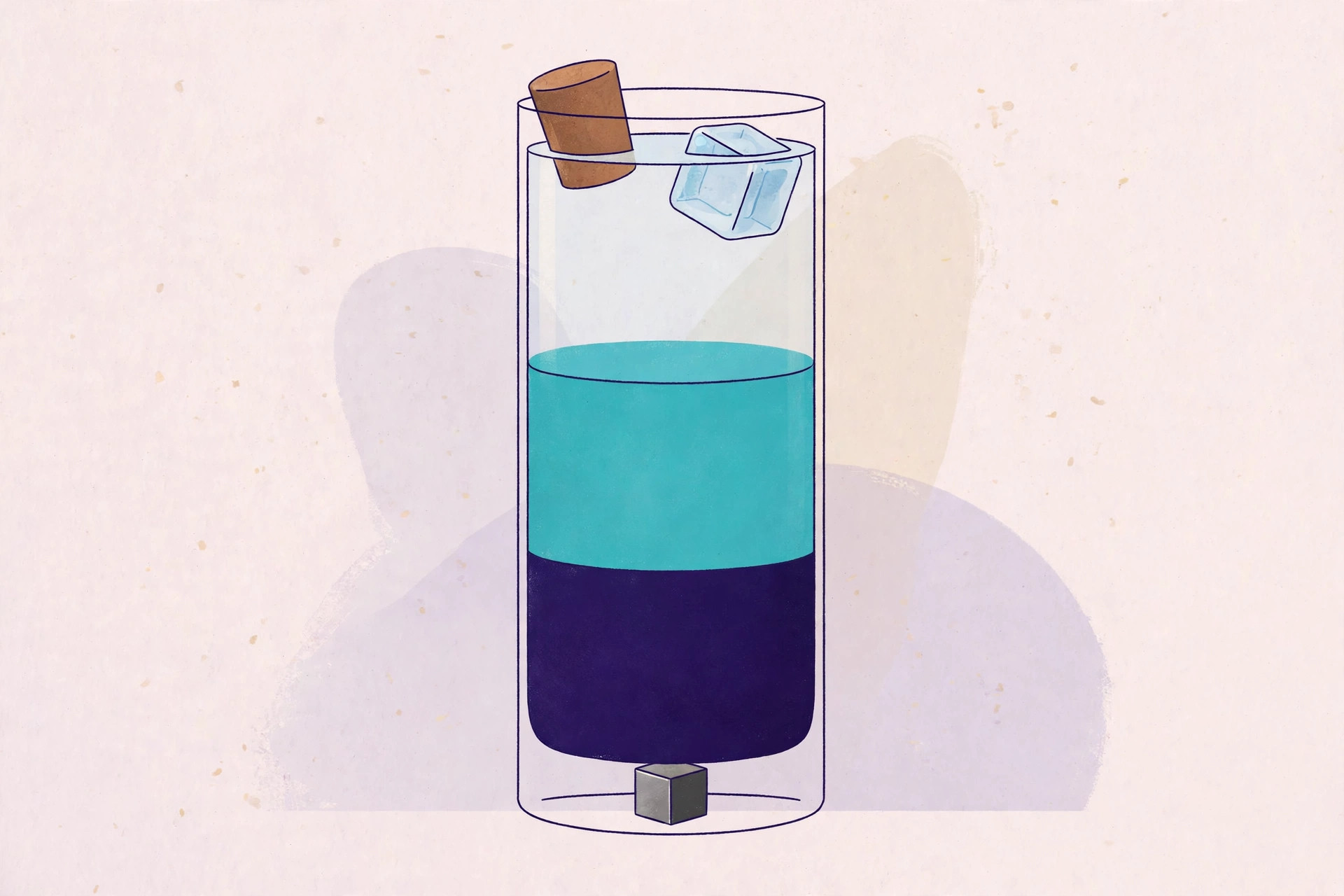
An object floats in a liquid denser than itself and sinks in one less dense, which is why ice, at 0.917 grams per millilitre, floats in water with about a tenth of its bulk above the surface, and why icebergs are mostly hidden. Ships float higher in salt water than in fresh because the sea is slightly denser. In the laboratory, density gradients separate mixtures, from cream rising on milk to the layered liquids in a density column. Temperature matters throughout: most substances expand and grow less dense when warmed, which drives convection currents in everything from radiators to oceans. Density also quietly polices the kitchen and the workshop. A fresh egg sinks in water and a stale one floats, because the egg loses moisture through its shell and its internal air pocket grows, lowering its average density week by week. Honey and oil frauds are detected by density checks, since adulterated products fall outside the honest range. Hydrometers, floating gauges that read density directly from how deep they sit, test everything from battery acid to brewing wort. A single ratio of two easy measurements turns out to be one of the most informative numbers a substance offers, which is why it is measured so often and so casually.
Try it yourself
The calculator that goes with this guide is ready on the tools page.
Open the density calculator