Dilution Explained: M1V1 = M2V2 in Practice
Dilution lowers a concentration by adding solvent. The M1V1 = M2V2 relationship, how to use it safely, and the serial dilutions used in real laboratories.
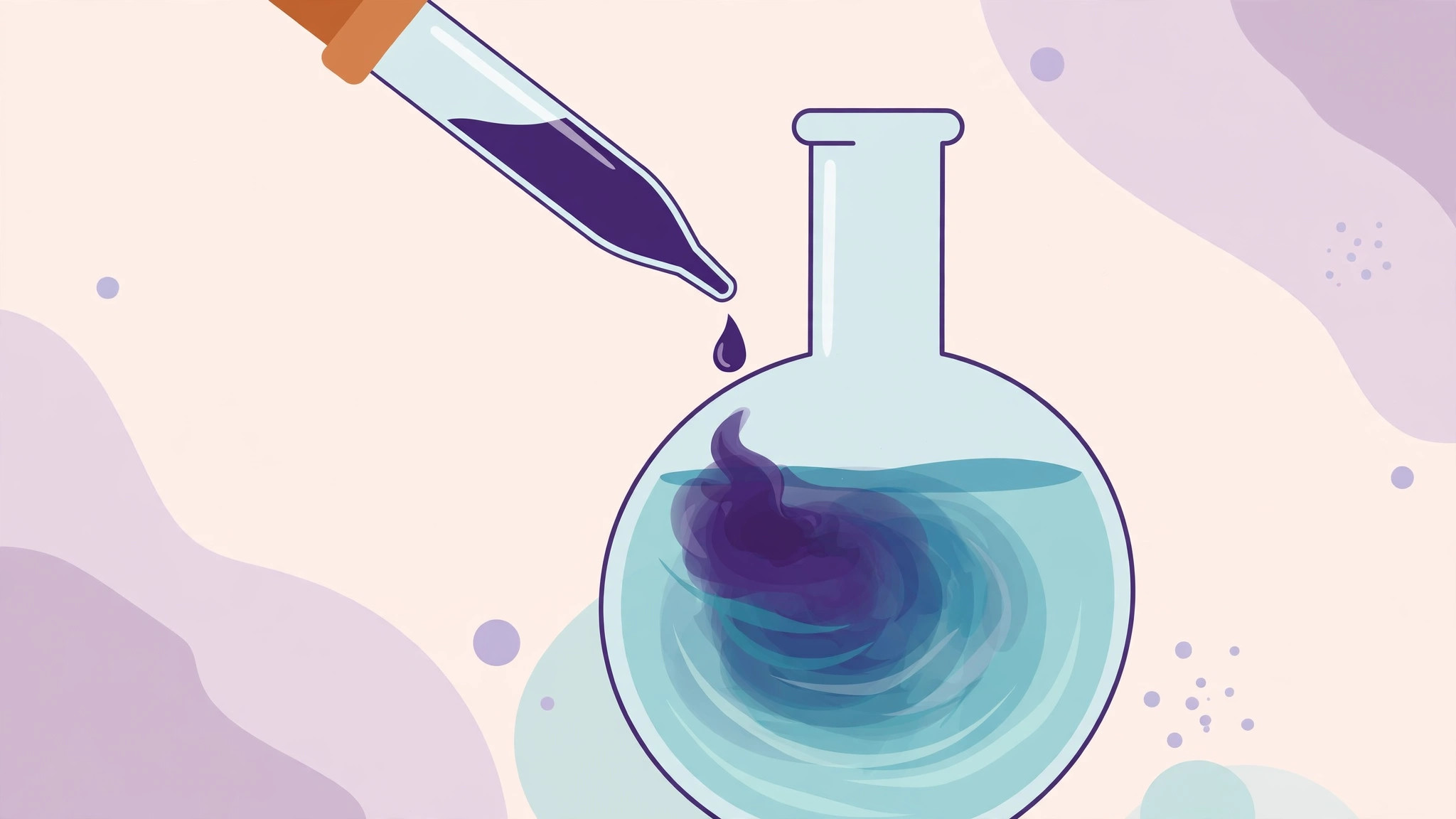
Adding solvent changes nothing else
When a solution is diluted, solvent is added and the amount of dissolved substance stays exactly the same. Because the moles of solute do not change, the product of concentration and volume before dilution equals the same product afterwards: M1V1 = M2V2. This single relationship answers almost every dilution question. If 50 millilitres of a 2 molar solution are made up to 200 millilitres, the moles present are 2 x 0.050, which is 0.1 moles, and the new concentration is 0.1 divided by 0.200, giving 0.5 molar. Notice that diluting to four times the volume quartered the concentration; dilution factors behave in this simple proportional way.
Using the equation in any direction
The same equation solves for whichever quantity is missing. To prepare 250 millilitres of 0.1 molar acid from a 1 molar stock, the volume of stock needed is 0.1 x 250 divided by 1, which is 25 millilitres, measured out and then made up to the full 250. The volumes on both sides must use the same unit, and the final volume is the volume of the finished solution, not the volume of water added. The dilution calculator on the tools page accepts any three of the four values and returns the fourth, which removes the rearranging step where most slips happen.
Serial dilution and laboratory practice
When a target concentration is far below the stock, laboratories dilute in steps, often tenfold at a time, because measuring a tiny volume accurately is hard while measuring a moderate one is easy. Three tenfold steps reach a thousandfold dilution with good accuracy at each stage. Safety matters here too: concentrated acids are always added to water, never the other way round, because the heat released can boil the first drops and spit acid. Volumetric flasks, filled to the mark at the stated temperature, give the volumes their accuracy, and a well mixed flask matters, because an unmixed dilution is really two different concentrations in one vessel. Dilution has a mirror image worth knowing: evaporation and boiling concentrate a solution by removing solvent while the solute stays, the same product rule running backwards. Cooks use it when reducing a sauce, and laboratories use it cautiously because heating can also decompose the solute. The safe general statement is that the amount of solute changes only when you add it, remove it or let it react; every other change in concentration is the volume moving around a fixed amount. Holding that one idea firmly makes dilution, evaporation and mixing problems all collapse into the same shape, and the same three known values always unlock the fourth.
Try it yourself
The calculator that goes with this guide is ready on the tools page.
Open the dilution calculator