Electrochemistry Basics: Chemistry That Carries Current
Electrochemistry studies the traffic between chemical reactions and electricity: cells that make current from reactions, and current that drives reactions.
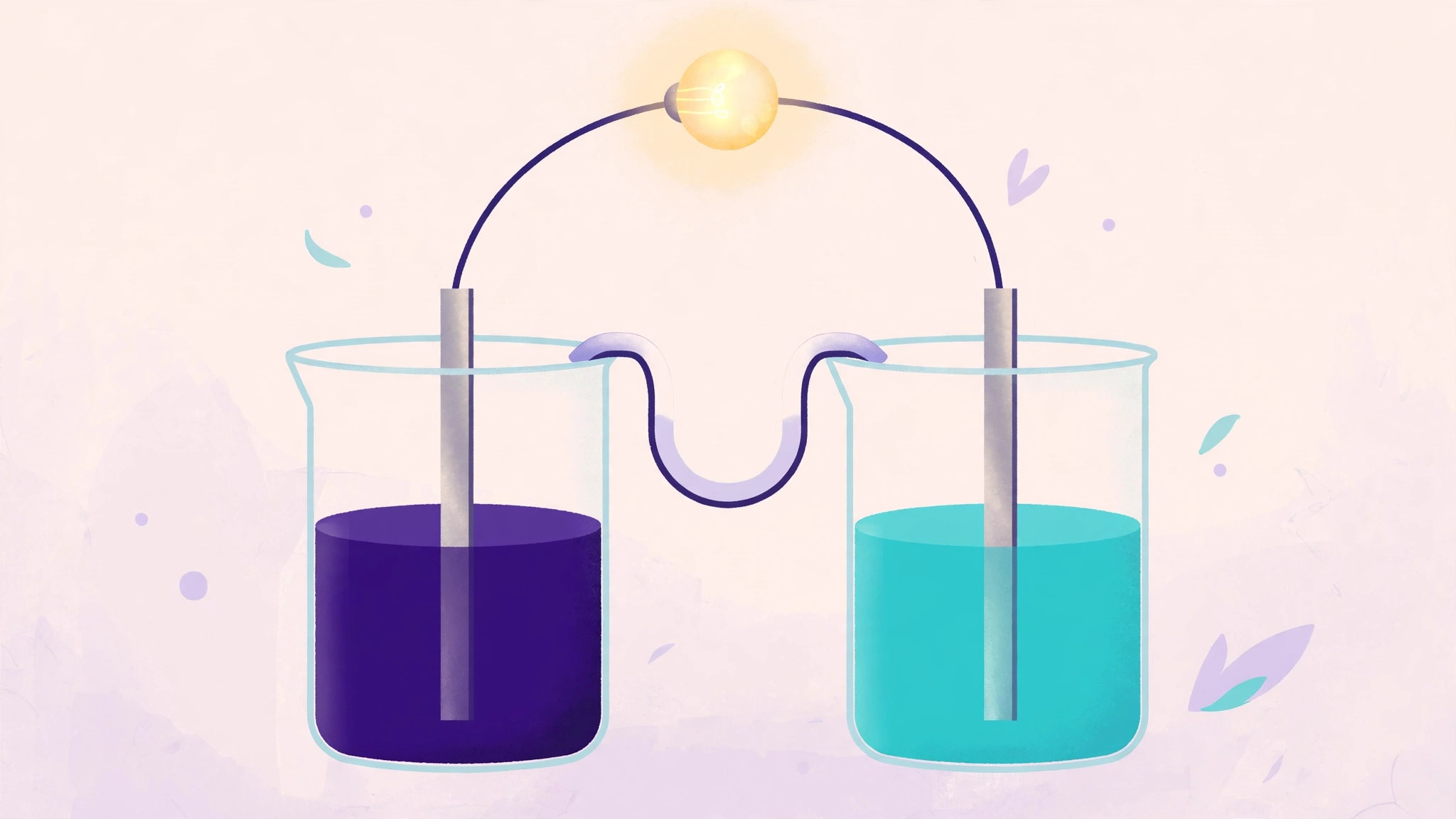
Reactions that push electrons
In a redox reaction electrons move from one substance to another. Electrochemistry separates the two halves of that traffic so the electrons are forced to travel through a wire, where their flow is an electric current that can do work. A cell built this way, with zinc giving electrons to copper ions through an external circuit, is the principle inside every battery. The two halves sit in separate compartments joined by a salt bridge that lets ions drift to complete the circuit. Reverse the arrangement, pushing current into a solution to force a reaction that would not run alone, and you have electrolysis.
Electrolysis and extraction
Electrolysis decomposes compounds with electricity. Passing current through molten aluminium oxide extracts aluminium, a metal too reactive to win from its ore by carbon, and the process consumes so much electricity that smelters are built beside hydroelectric power. Electrolysis of brine produces chlorine, hydrogen and sodium hydroxide, three industrial staples from one salty feedstock. Water itself splits into hydrogen and oxygen, a route to green hydrogen when the electricity is renewable. The amounts follow Faraday's laws: the quantity of substance produced is proportional to the charge passed, counted in moles of electrons, so the mole arithmetic of this site returns in electrical dress.
Batteries, corrosion and plating
Rechargeable batteries run their cell reaction backwards during charging, storing the energy to run it forwards again on demand. Electroplating uses electrolysis to coat objects with a thin skin of chromium, silver or gold, the object's surface becoming one electrode of the cell. Corrosion is the unwanted version of the same science, iron forming tiny cells with water and oxygen and dissolving itself away, prevented by barriers, by galvanising with zinc, or by attaching a more reactive sacrificial metal that corrodes in the iron's place. One idea, electrons made to travel, explains the battery in a phone, the chrome on a tap and the rust on a gate. The reactivity series organises the whole topic into one ranking. Metals higher in the series give up electrons more readily, form cells with greater voltage against those below them, and displace the lower metals from their compounds. A Daniell cell pairs zinc with copper for about 1.1 volts; pair lithium with fluorine chemistry and modern batteries reach beyond 3 volts per cell, which is why lithium batteries power phones while zinc carbon cells power clocks. The series also predicts corrosion's pecking order and extraction's methods: the higher a metal sits, the harder its compounds hold it, and the more likely electricity, rather than carbon, must do the extracting.
Try it yourself
The calculator that goes with this guide is ready on the tools page.
See redox links in the guides