Electron Configuration: Where the Electrons Live
Electron configuration describes how electrons arrange themselves in shells around the nucleus. The filling order and how it explains the periodic table's shape.
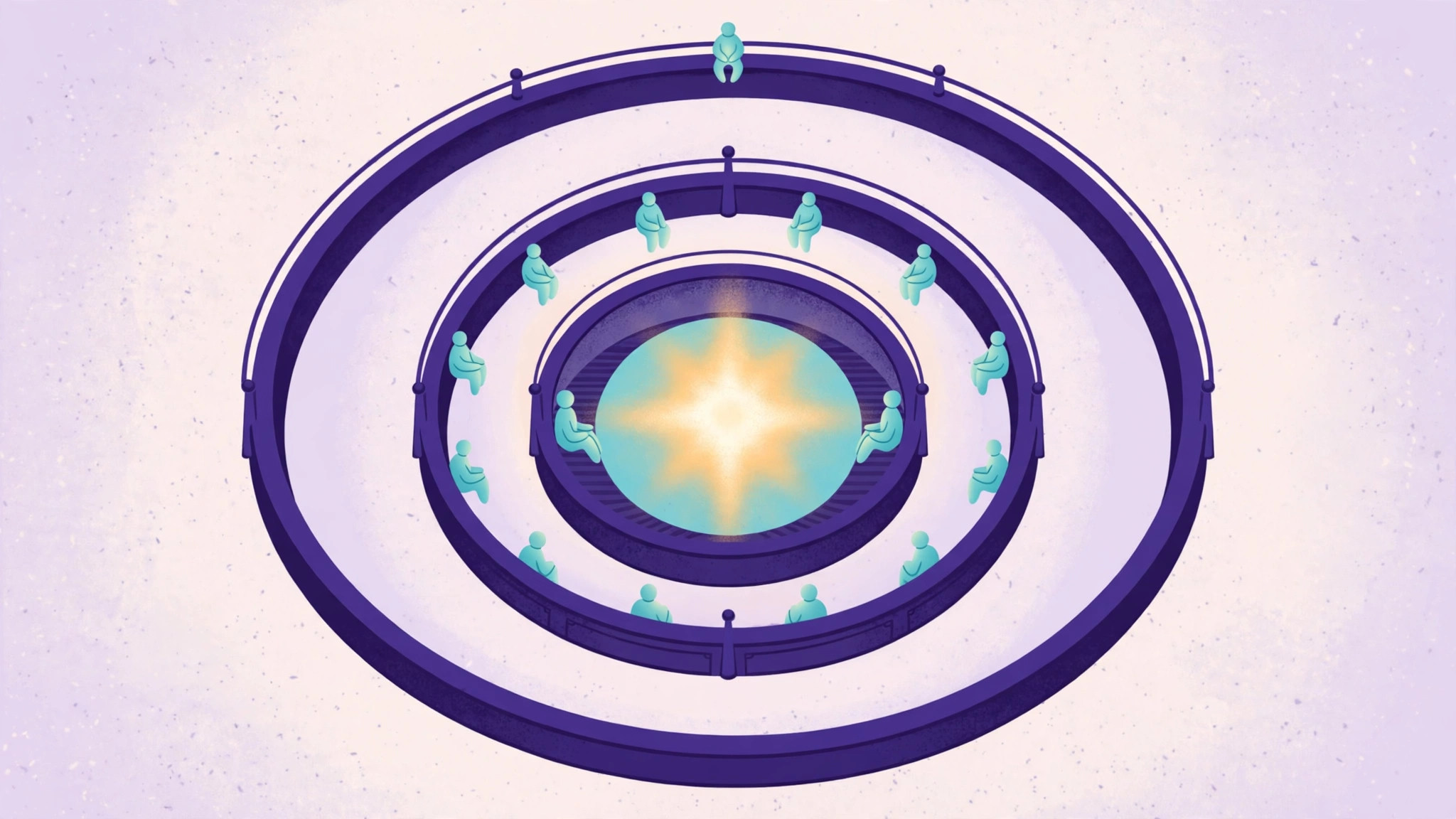
Shells within shells
Electrons occupy shells at increasing distance and energy from the nucleus, and within the simple model used for the first twenty elements the shells hold 2, then 8, then 8 electrons in the pattern that builds the periodic table's first rows. Sodium, with 11 electrons, is written 2,8,1: a full first shell, a full second, and one lone electron in the third. That single outer electron is sodium's whole personality: easily lost, making the Na+ ion, driving violent reactions with water, and placing sodium in group 1 beside lithium at 2,1 and potassium at 2,8,8,1, whose configurations rhyme in exactly the way their chemistry does.
The filling order and its logic
Electrons fill the lowest available energy level first, which is why the third shell pauses at 8 for potassium and calcium before the fourth shell's extra spaces begin to fill with the transition metals. Beyond calcium the picture refines into subshells, labelled s, p, d and f, with their own capacities and a filling order that explains the table's blocks: the wide transition block in the middle is the d subshell filling, and the long rows at the bottom are the f subshell. The notation compresses accordingly, iron written as [Ar] 3d6 4s2, but the school shell model remains the right first map, accurate for the elements that dominate everyday chemistry.
Configuration explains behaviour
Nearly every chemical property can be traced back to the outer shell. Atoms with full outer shells, the noble gases, are content and unreactive. Atoms one electron short, the halogens, grab electrons eagerly; atoms with one to spare, the group 1 metals, give eagerly, and when the two meet the reaction is vigorous precisely because both reach a full shell in the exchange. Ion charges, the formulas of compounds, the metallic character gradient across the table, even the sizes of atoms, all follow from these arrangements. Configuration is the theory underneath the periodic table's map, and the two are best learned together, each explaining the other. The same logic explains the shapes of ions and the sizes of atoms across the table. Atoms shrink across a period, because extra protons pull the same shell tighter, and grow down a group, because each new element adds a whole shell. When a metal atom loses its outer electrons to form an ion, the ion shrinks further, since a shell is lost and the remaining electrons are held more tightly; when a non metal gains electrons, its ion swells. These are not extra facts to memorise but the configuration model doing its work, and they predict everything from lattice energies to why sodium ions slip through biological channels that potassium ions also use.
Try it yourself
The calculator that goes with this guide is ready on the tools page.
Relate it to the periodic table guide