Gas Laws in Real Life: Lungs, Balloons and Tyres
The gas laws are not abstractions: lungs, weather balloons, aerosol cans and car tyres all obey them daily. A tour of the laws at work around you.
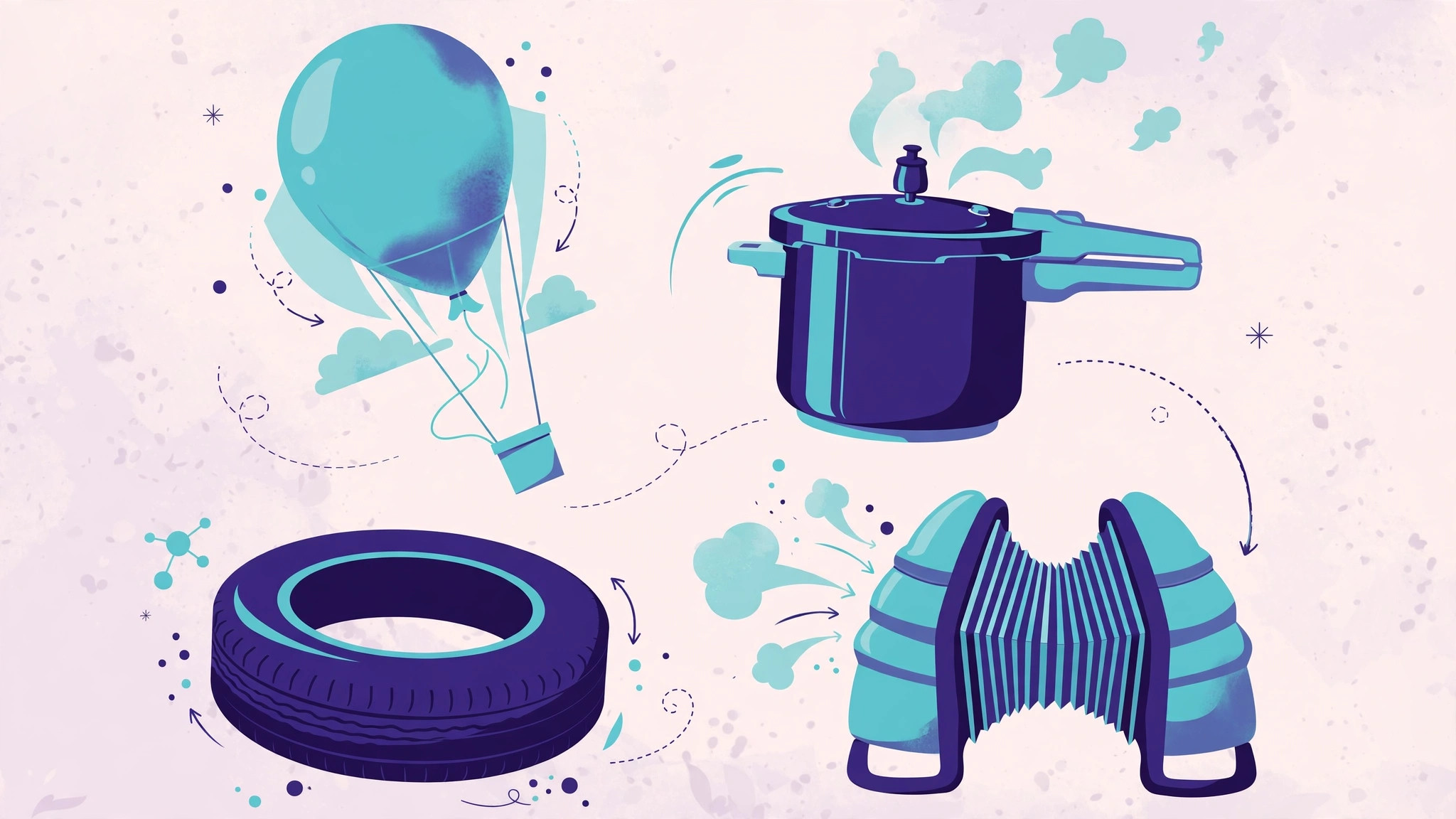
Breathing, balloons and tyres
Every breath is Boyle's law: the chest expands, internal pressure drops below the air outside, and air flows in until the pressures match. A weather balloon launched partly filled swells as it climbs into thinner air and bursts near the top of the atmosphere, exactly as the inverse pressure and volume relationship predicts. Car tyres lose pressure on cold mornings by the combined law, because the air inside cools at nearly fixed volume. Aerosol cans carry their warning about heat because a fixed volume of gas, warmed, raises its pressure without limit until the can fails. The laws were written from laboratory glassware, but they govern every sealed and breathing container in daily life.
Cooking and altitude
Pressure cookers exploit the gas laws from the other side: sealing steam in raises the pressure, which raises the boiling point of water, which cooks food faster. At altitude the opposite bites, because lower air pressure lets water boil below 100 degrees, so eggs take longer and recipe timings drift. Mountain climbers and pilots meet the amount side of the story, since the air at height contains fewer moles per litre, and the ideal gas law quantifies exactly how much less oxygen each breath delivers. The same equation sizes the oxygen cylinders that compensate for it.
Industry runs on the same page
Compressed gas cylinders, refrigeration cycles, air conditioning, internal combustion and the storage of natural gas are all engineered with PV = nRT and its relatives as the first approximation. Even the deviations are informative: where a real gas bends away from the ideal law, at high pressure or near condensation, engineers learn that molecular size and attraction have become important and switch to corrected equations. Meeting the laws in daily objects first makes the algebra feel like what it is, a compressed description of behaviour you have already watched a balloon, a lung and a tyre perform. One more everyday instrument deserves its place: the pressure cooker gauge, the weather forecaster's barometer and the altimeter in an aircraft are all gas law instruments, reading pressure and translating it into a cooking time, a forecast or a height. The altimeter is the most dramatic translation, since it reports altitude while measuring only pressure, trusting the atmosphere to thin with height in the predictable way the gas laws describe. When its setting is wrong, the reading is wrong by a fixed offset, a reminder that every gas law application carries its assumptions with it, printed or not.
Try it yourself
The calculator that goes with this guide is ready on the tools page.
Try the gas law calculators