Half-Life Explained: The Clock That Halves
Half-life is the time for half of a radioactive sample to decay. How the pattern works, why it never reaches zero, and how it dates ancient objects.
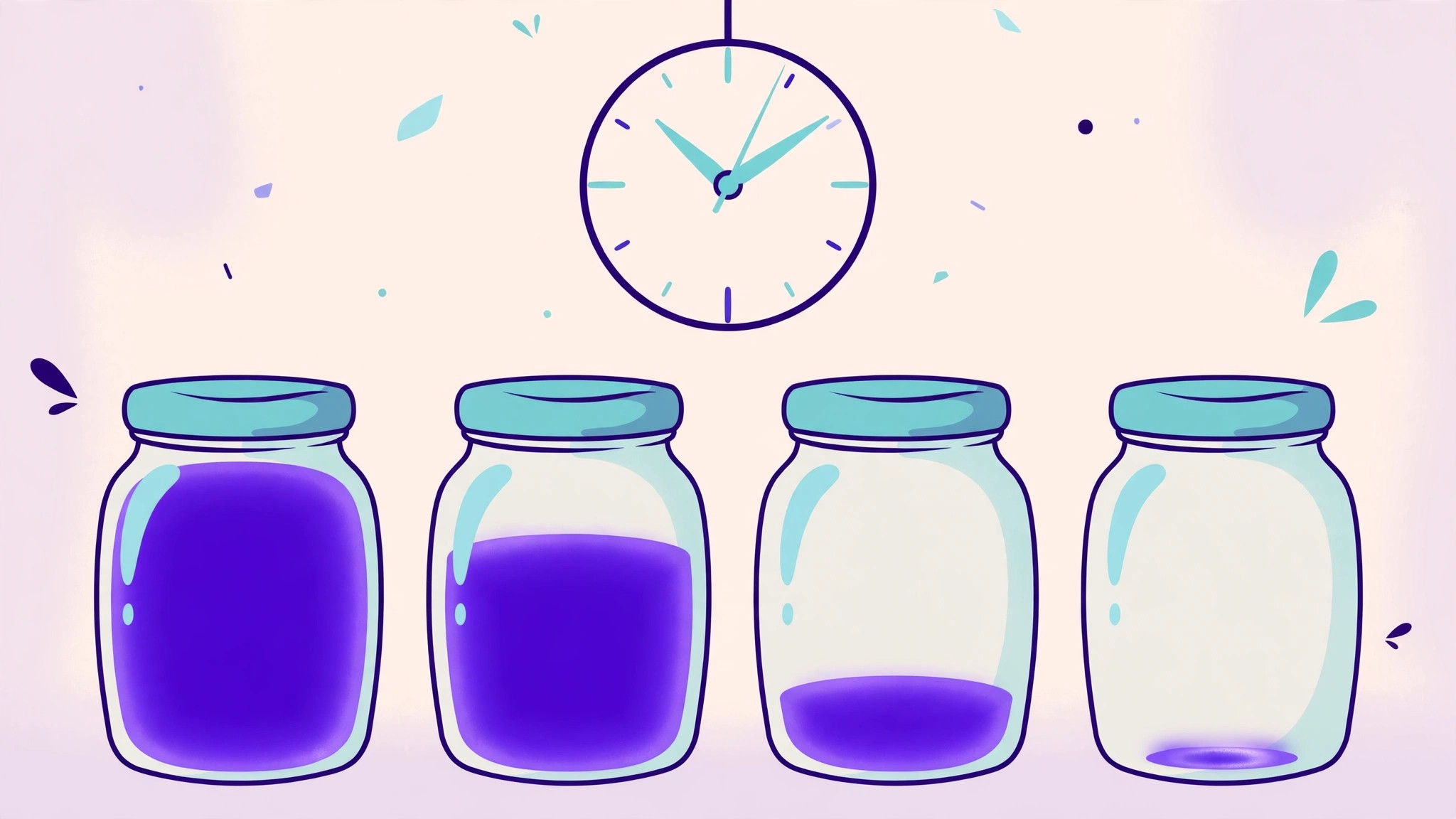
Halving, again and again
A radioactive isotope decays at a rate described by its half-life: the time in which half of the atoms present transform into something else. After one half-life half remains; after two, a quarter; after three, an eighth. The amount follows the rule start times one half raised to the number of half-lives passed, which the half-life calculator on the tools page applies for any starting amount and time. The pattern never quite reaches zero, it only grows vanishingly small, and it does not depend on how much you start with: a kilogram and a milligram of the same isotope halve on the same schedule.
A clock built into matter
Because the schedule is so reliable, half-lives work as clocks. Carbon 14, with a half-life of about 5,730 years, is made in the atmosphere and absorbed by living things; when an organism dies the intake stops and the carbon 14 decays away, so the fraction remaining in old wood, cloth or bone reports the time since death, usefully back to about fifty thousand years. Older rocks are dated with slower clocks, uranium and potassium isotopes with half-lives in the billions of years, which is how the age of the Earth itself, about 4.5 billion years, was measured rather than guessed.
Medicine and safety use the same maths
Medical tracers are chosen for short half-lives, active long enough to image an organ and then gone within days. The same decay law schedules their delivery, since a dose prepared on Monday is measurably weaker by Wednesday. In safety work, half-life sets the timescale of a hazard: iodine 131, at eight days, fades within months, while plutonium 239, at twenty four thousand years, demands containment on civilisational timescales. The calculation is always the same halving; only the clock speed changes, and reading a half-life correctly is mostly a matter of counting how many halvings fit into the time in question. The mathematics has one more surprise worth meeting early: after ten half-lives, less than a thousandth of the original remains, whatever the starting amount or the isotope. This thousandfold rule of thumb lets workers estimate shielding and storage times quickly, and it explains why short lived medical isotopes can be used so freely: ten half-lives of a six hour tracer is two and a half days to a thousandth of the dose. The same rule, run in reverse, shows why dating works only within a window: too few half-lives and nothing has measurably changed; too many and too little remains to measure at all.
Try it yourself
The calculator that goes with this guide is ready on the tools page.
Open the half-life calculator