Ionic and Covalent Bonds: Transfer or Share
Ionic bonds transfer electrons between atoms; covalent bonds share them. How the two bond types form and how they decide a substance's properties.
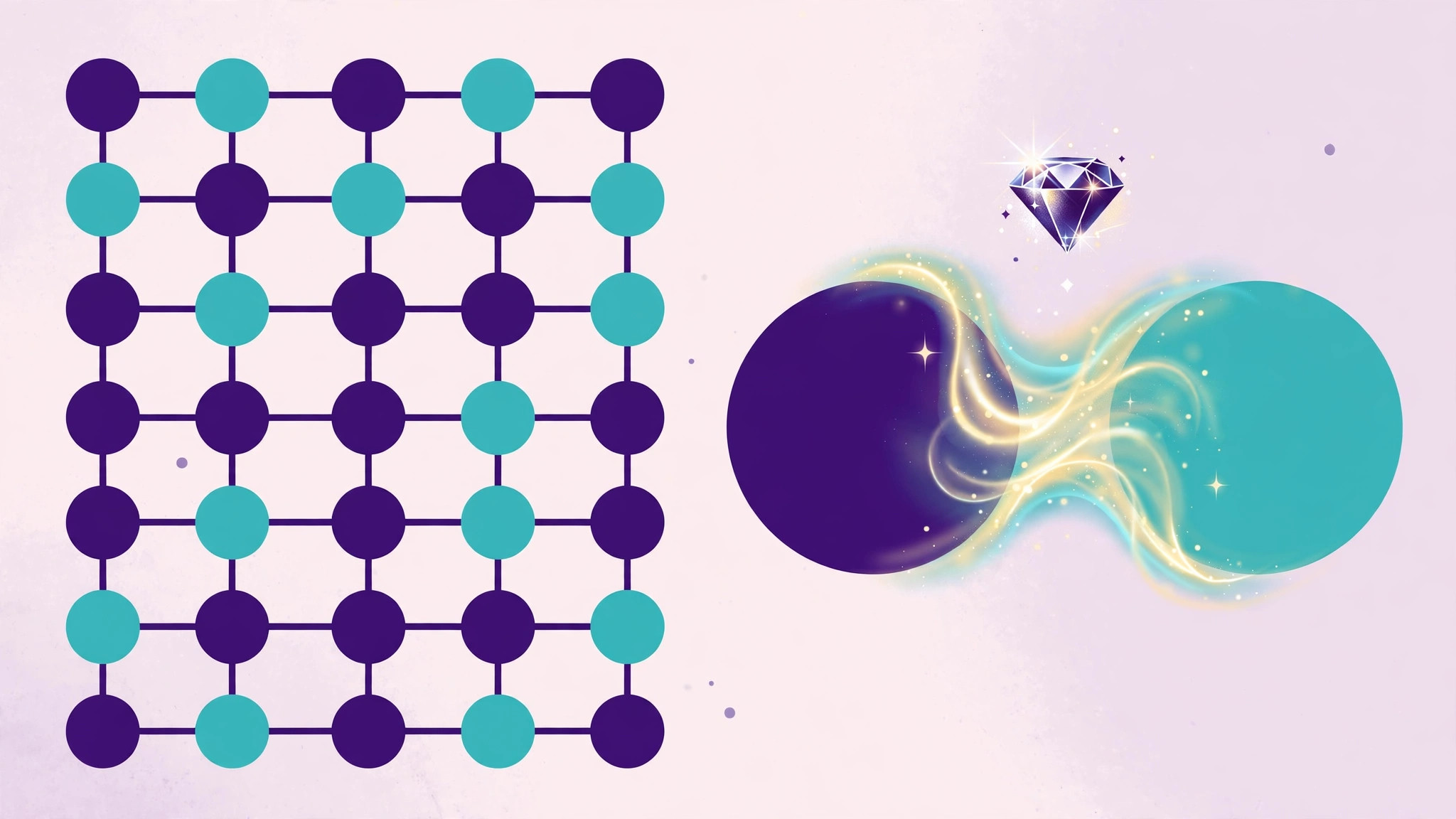
Transfer versus sharing
Atoms bond to reach a more stable electron arrangement, and they do it in two main ways. In an ionic bond, one atom gives electrons to another outright: a sodium atom hands its outer electron to a chlorine atom, both become ions, and the attraction between opposite charges holds them together. In a covalent bond, atoms share pairs of electrons between them, as two hydrogen atoms share their electrons in an H2 molecule. The difference is driven by the atoms involved: metals with non metals tend to transfer, giving ionic compounds, while non metals among themselves share, giving covalent molecules. Many real bonds sit between the pure cases, sharing unevenly.
Properties follow the bond
The bond type predicts the substance's behaviour with remarkable reliability. Ionic compounds form giant crystal lattices with very high melting points, conduct electricity when molten or dissolved because their ions can move, and often dissolve in water. Simple covalent molecules, like methane or oxygen, have low melting and boiling points because the forces between molecules are weak even though the bonds inside them are strong, and they never conduct. Giant covalent structures such as diamond and silicon dioxide break the low melting pattern, because melting them means breaking the strong bonds themselves, which is why diamond is among the hardest and highest melting substances known.
Seeing bonds in formulas
A formula quietly announces its bonding: a metal written with a non metal, NaCl, MgO, Ca(OH)2, signals an ionic compound whose name and charges follow the group patterns of the periodic table, while formulas of only non metals, CO2, NH3, C6H12O6, signal covalent molecules. The distinction matters in calculations too, because ionic compounds are counted in formula units rather than molecules, and their solutions contain separated ions in the ratios of the formula. Every molar mass on this site is computed the same way regardless, but what the resulting number describes, a mole of molecules or a mole of formula units, depends on the bond type behind the formula. Melting points make the difference tangible in one demonstration. A spatula of sodium chloride held in a Bunsen flame barely softens, since the lattice needs 801 degrees Celsius to melt, while a spatula of sugar, a covalent compound, melts and then chars below 200 degrees, because only the weak forces between its molecules must be overcome. Wax, butter and ice all melt in a warm room for the same reason. When an unknown substance melts on a hot plate at low temperature, refuses to conduct when molten, and will not dissolve in water, the evidence has already voted: its particles are molecules, and its bonds are covalent.
Try it yourself
The calculator that goes with this guide is ready on the tools page.
Weigh ionic and covalent formulas