Isotopes Explained: Same Element, Different Neutrons
Isotopes are atoms of the same element with different numbers of neutrons. Why they share chemistry but differ in mass, stability and usefulness.
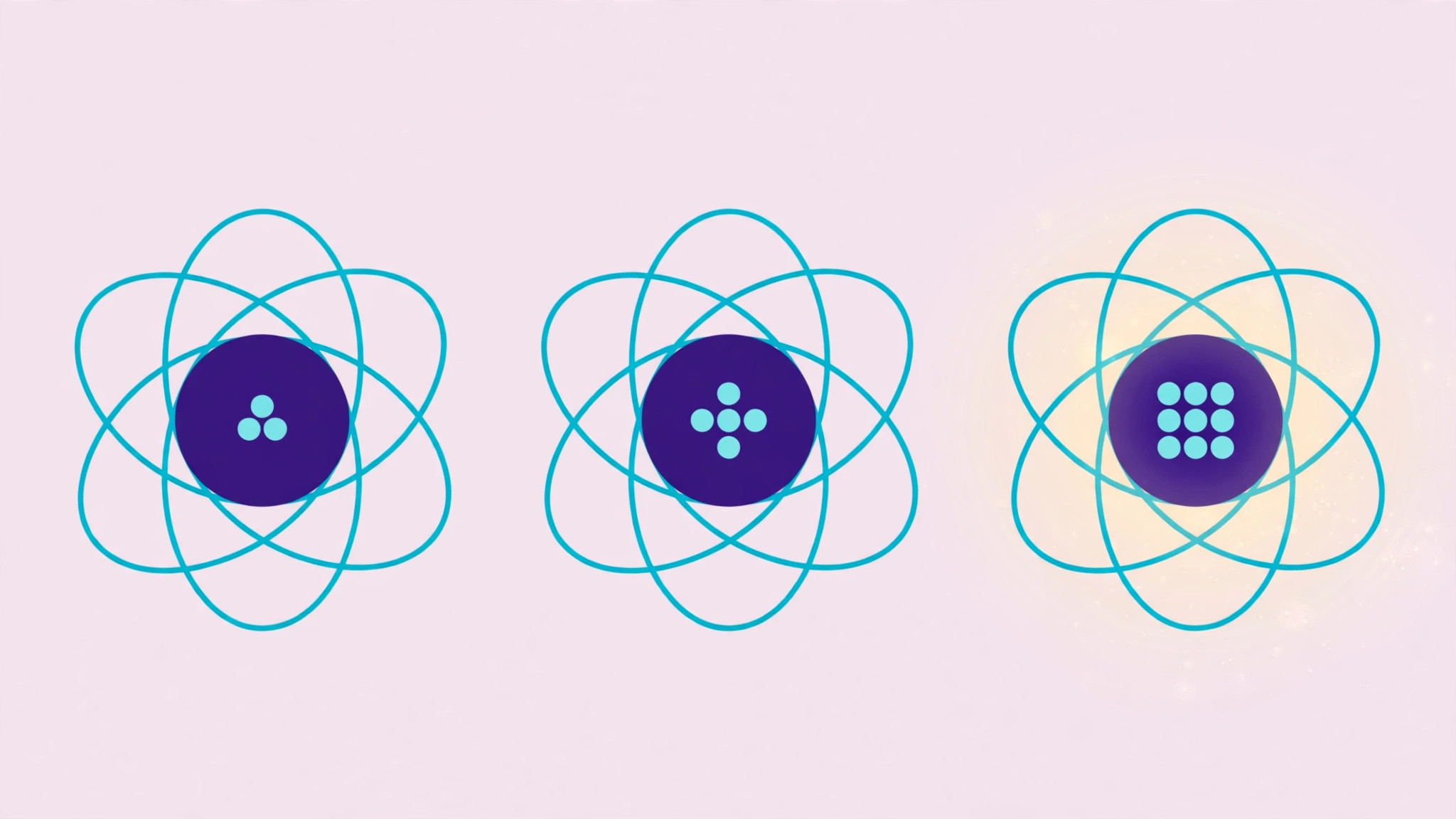
Same element, different weight
Every atom of an element has the same number of protons, which fixes its identity, but the number of neutrons can vary. These variants are isotopes: carbon 12 and carbon 14 both have six protons, with six and eight neutrons respectively. Because chemistry is governed by electrons, and electron arrangement follows the proton count, isotopes behave almost identically in reactions. Their masses differ, though, and so do their nuclear properties: some isotopes are stable forever, others are radioactive and decay, which is why carbon 14 can date ancient wood while carbon 12 builds the wood in the first place.
Why atomic masses are not whole numbers
Isotopes explain the periodic table's untidy atomic masses. Chlorine's 35.45 is the average of its two stable isotopes, chlorine 35 at about 75 percent abundance and chlorine 37 at about 25 percent, weighted by how common each is. The average is what a mole of the natural element weighs, so it is the right value for molar mass calculations, and it is the value built into this site's calculators. A mass spectrometer separates isotopes by mass and measures their proportions, which is how the averages are known and how isotope ratios in a sample can report its origin, from the water a wine grape drank to the diet of a mummified traveller.
Isotopes at work
Medicine uses radioactive isotopes as tracers and treatments, industry uses them to gauge thickness and find leaks, and power stations split the rare fissile isotope uranium 235, which is chemically inseparable from uranium 238 and must be enriched by physical methods exploiting the tiny mass difference. Stable isotopes serve quieter roles as labels: feed a plant heavy water or labelled carbon dioxide and the label can be followed through its chemistry like a marked banknote. One element, several weights, and a set of applications that all rest on the neutron's indifference to chemistry and importance to everything else. One caution completes the picture: isotopes of the same element are chemically almost identical, but not quite. The lightest element shows the largest effect, because hydrogen's isotopes differ proportionally the most: heavy water, made with deuterium, is measurably denser and slightly slower in reactions, and in quantity it disturbs biology enough to be toxic to some organisms. These kinetic isotope effects are small for heavier elements and are used as delicate probes of reaction mechanisms, letting chemists ask which bond breaks in the slow step of a reaction by watching which isotopic substitution slows it. Almost identical, it turns out, is a rich source of information.
Try it yourself
The calculator that goes with this guide is ready on the tools page.
See averages in atomic masses