Laboratory Safety Basics: Habits That Protect
Laboratory safety is a set of habits built from other people's accidents. The core rules for eye protection, heating, chemicals and clear thinking at the bench.
Eyes, skin and the non negotiables
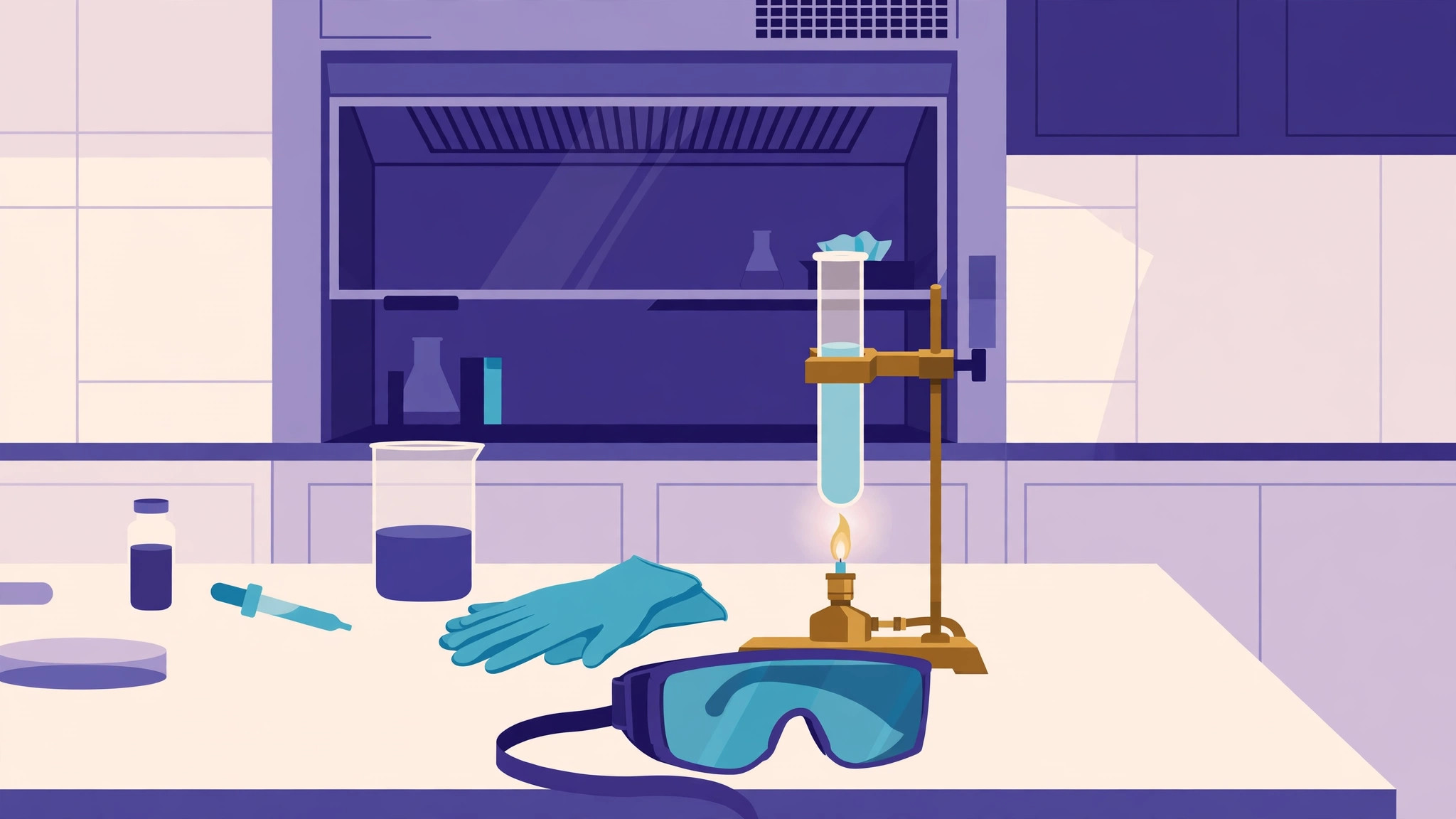
The rules that protect you are few and absolute. Eye protection goes on before any chemical is opened and stays on until everything is washed and put away, because the accidents that take sight are the fast ones: a spitting liquid, a shattering tube. Hot glassware looks exactly like cold glassware, so it is handled as if hot until proved otherwise, and burns are run under cold water for long minutes, not seconds. Nothing is tasted, ever, and smelling a chemical, when a procedure requires it, is done by wafting vapour toward the nose with a hand, never by inhaling over the vessel. Long hair and loose sleeves are tied back before flames appear.
Heating, acids and glassware discipline
Test tubes being heated point away from everyone, including their owner, and are kept moving so the liquid does not bump and eject. Acids are diluted by adding acid to water, in that order, so the heat released spreads through the larger volume. Cracked glassware is retired, not risked, because heat and pressure find cracks. Spills are reported and dealt with by the procedure for that chemical, not by improvisation, and every reagent bottle returns to its place with its lid on, because the next person's safety depends on labels meaning what they say. Fume cupboards exist for volatile and toxic substances and are used with the sash at the marked height, where the airflow actually protects.
Thinking as the deepest rule
Underneath the specific rules sits one habit: know what you are about to do before you do it. Read the whole procedure first, identify the step where something could go wrong, and decide in advance what you will do if it does. Risk assessments are this habit written down, matching each chemical's hazards, from the hazard pictograms on its bottle, to the precautions in the plan. Chemistry has an honourable safety record in teaching laboratories precisely because the habits are taught as part of the subject, not as an interruption to it. The calculations on this site are the safe half of chemistry; the bench half deserves the same care. It is worth saying plainly what this guide is and is not. It is a summary of the habits taught in school and university laboratories, offered as background reading for students meeting practical work. It is not a substitute for the risk assessment, supervision and local rules of your own institution, which always take precedence and which your teacher or technician will explain for each practical. Safety rules differ in detail between workplaces because the chemicals and equipment differ; the underlying habit, understanding a procedure and its hazards before beginning, is the part that travels everywhere chemistry is done.
Try it yourself
The calculator that goes with this guide is ready on the tools page.
Handle the numbers safely too