The Limiting Reactant: The Ingredient That Runs Out
The limiting reactant is the ingredient that runs out first and caps the amount of product. How to identify it and why the other reactant is left over.
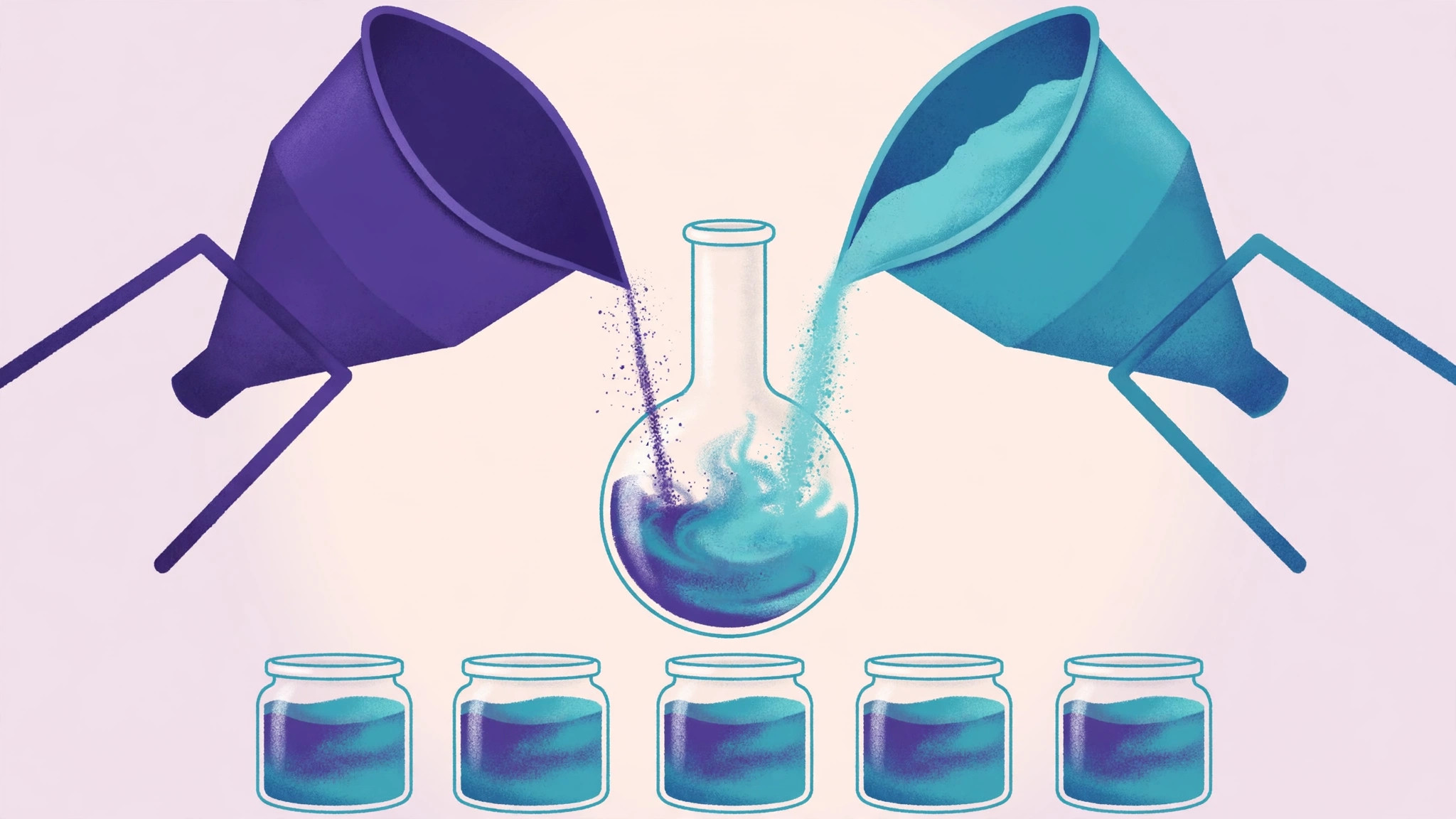
The ingredient that runs out
A reaction stops when one reactant is used up, and that reactant, the limiting reactant, decides how much product can form. The other reactant, present in excess, is simply left over. A sandwich analogy makes it plain: with ten slices of bread and seven cheese slices, cheese limits you to seven sandwiches however much bread remains. In the laboratory the same logic applies with moles and coefficients. The reactant present in the smallest amount relative to the equation's demands is the one that runs out, and it is not always the one with the smaller mass or the smaller number of moles, because the equation may demand them in unequal proportions.
Finding it reliably
The reliable method compares each reactant with the equation. Divide the moles of each reactant by its coefficient in the balanced equation; the smallest result belongs to the limiting reactant. Take hydrogen and oxygen making water, two moles of hydrogen per mole of oxygen. Five moles of hydrogen divided by its coefficient 2 gives 2.5; three moles of oxygen divided by 1 gives 3. Hydrogen has the smaller value, so hydrogen limits the reaction, producing 5 moles of water and leaving half a mole of oxygen unused. The limiting reactant calculator on the tools page performs this comparison from masses directly and reports the theoretical yield in the same step.
Why it matters beyond the classroom
Industry lives on this calculation. Manufacturers deliberately make one reactant the limiting one, usually the expensive or hazardous ingredient, so that it is consumed completely and nothing valuable is wasted or left to separate afterwards. The cheap reactant is used in excess to push the valuable one to completion. In environmental chemistry the same reasoning predicts how much pollutant a quantity of fuel or reagent can generate. Whenever a question asks how much product a mixture can make, the limiting reactant must be found first; assuming the first reactant named is the one that matters is the most common and most costly mistake in reaction arithmetic. A shortcut sometimes tempts students: picking the reactant with the smaller mass, or the smaller number of moles, as the limiting one. Both shortcuts fail whenever the coefficients differ, as the hydrogen and oxygen example showed, where the reactant with more moles was not the one in excess relative to demand. The division by coefficients takes only seconds longer and is never wrong, which makes it one of the best bargains in the subject. In written work it also shows the examiner your reasoning, so that even a later arithmetic slip leaves a trail of correct method behind it.
Try it yourself
The calculator that goes with this guide is ready on the tools page.
Find the limiting reactant