pH and pOH Basics: The Scales of Acidity
The pH scale measures acidity on a scale built from hydrogen ion concentration. What pH and pOH mean, how they connect, and how to convert between them.
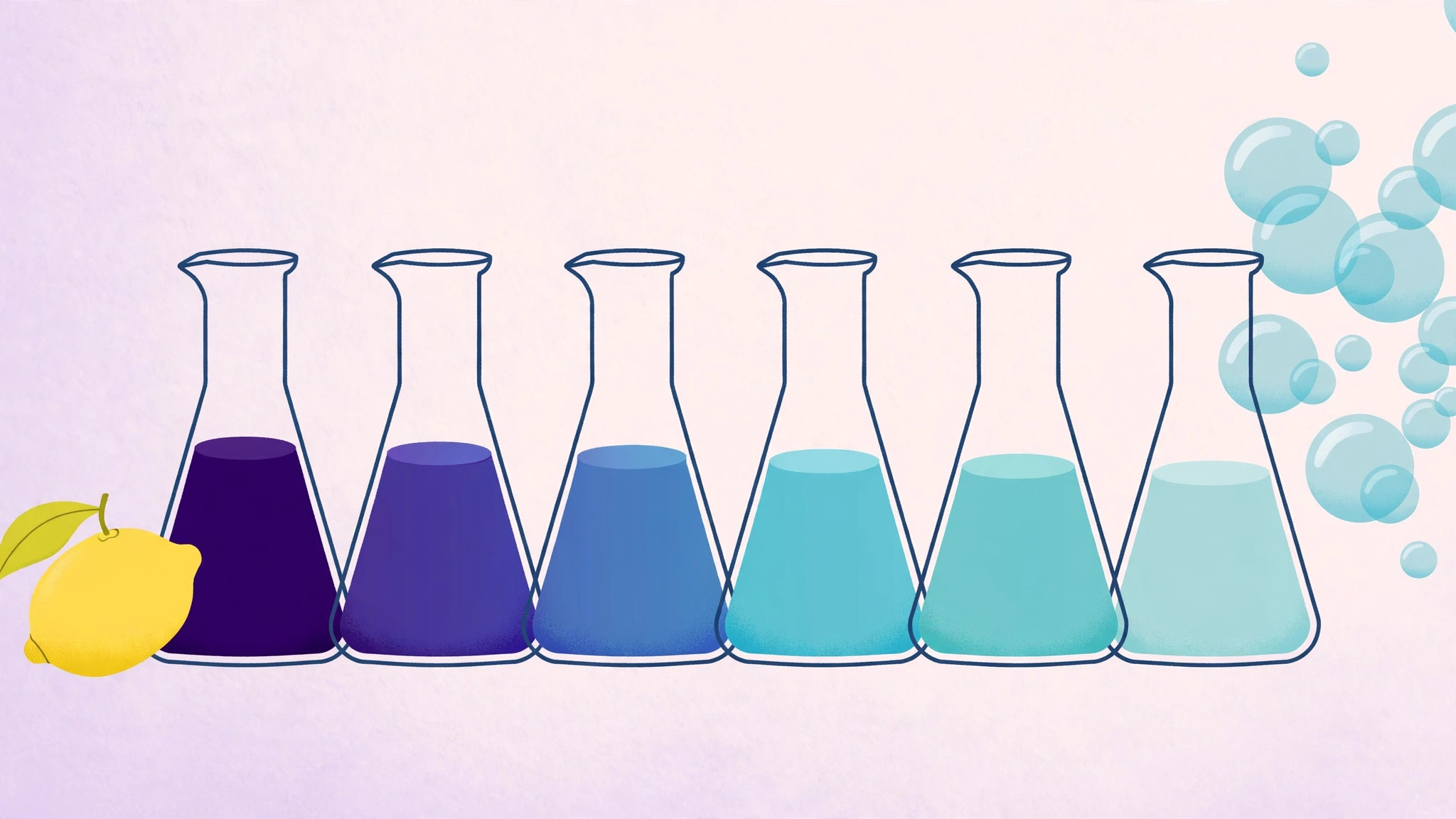
A shortcut for very small numbers
Pure water contains hydrogen ions at a concentration of just 0.0000001 moles per litre, and acid concentrations in real problems range over many powers of ten. Writing such numbers is clumsy, so pH compresses them: pH is the negative logarithm of the hydrogen ion concentration. A concentration of 0.01 moles per litre, which is 10 to the power of minus 2, gives a pH of exactly 2. Each whole step on the pH scale is a tenfold change in concentration, so a pH 3 solution is ten times as acidic as pH 4 and a hundred times as acidic as pH 5. Low pH means high hydrogen ion concentration; the scale runs opposite to the quantity it describes.
pOH and the number 14
Hydroxide ions get the same treatment: pOH is the negative logarithm of the hydroxide ion concentration. In water at 25 degrees Celsius the two scales are locked together by the relationship pH + pOH = 14, because the product of the two ion concentrations is fixed at 10 to the power of minus 14. A solution with pH 3 therefore has pOH 11, and a neutral solution sits at pH 7 with both ion concentrations equal. The pH calculator on the tools page moves between all four quantities at once, so entering any one of pH, pOH, or either concentration shows the complete picture.
Reading the scale sensibly
The familiar range runs from 0 to 14, but the scale does not stop there: a concentrated strong acid can have a negative pH, and a concentrated strong base can pass 14. Temperature shifts the neutral point slightly, because the ion product of water changes with temperature; at 37 degrees neutral water has a pH near 6.8, and it is still neutral, because the two ion concentrations remain equal. The everyday meaning of pH survives all of this: below 7 acidic, above 7 alkaline, and each unit a factor of ten. That factor of ten is the part worth remembering whenever a small pH difference is described as if it were a small change. Measuring pH honestly takes a little care. Indicator papers give a quick colour estimate, good to about half a unit, while a calibrated pH meter reads to a hundredth of a unit. Litmus, the oldest indicator of all, answers only the yes or no question of acid or alkaline. Soil kits, aquarium tests and swimming pool strips are all indicator chemistry in work clothes, and their colour charts are printed pH scales. Whichever tool is used, the number it reports is a logarithm in disguise, and remembering the tenfold step behind each unit keeps small numerical differences from being read as small chemical effects.
Try it yourself
The calculator that goes with this guide is ready on the tools page.
Open the pH calculator