Polymers in Daily Life: Chains That Changed the World
Polymers are giant molecules built from repeating units, and they make up plastics, fibres and much of biology. How they form and why they are hard to escape.
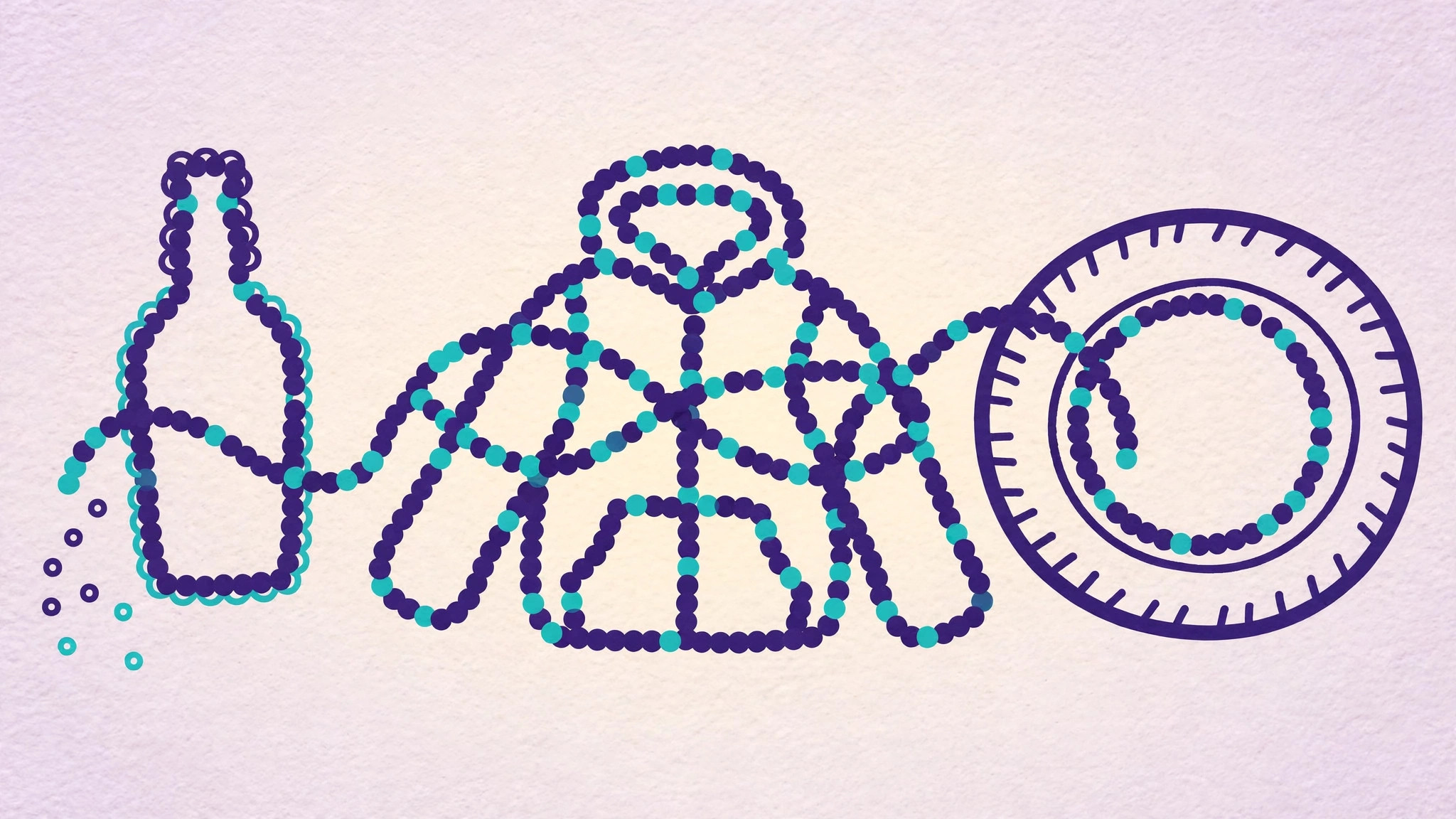
From monomers to giants
A polymer is a molecule built from hundreds or thousands of small identical units, the monomers, joined into a chain. Polythene forms when ethene molecules open their double bonds and link hand to hand in addition polymerisation, needing no other reagent and losing nothing. Other polymers form by condensation, shedding a small molecule such as water at each join: nylon and polyester, and, in nature, proteins from amino acids and starch from glucose. The resulting chains have molar masses in the tens or hundreds of thousands, far beyond ordinary molecules, and their formulas are written as a repeating unit in brackets with a subscript n for the unknown count.
Properties from structure
Polymer behaviour follows from chain structure. Long chains tangle and attract each other weakly at countless points, giving plastics their toughness and flexibility. Cross links between chains, as in vulcanised rubber and thermosetting resins, lock the tangle into a rigid network that will not melt. Branched chains pack poorly and give soft, low density material; straight chains pack closely into stiffer, denser stock. Plasticisers slip between chains to soften them, which is how one polymer, PVC, serves both as drainpipe and as raincoat. The chemistry of a plastic object is mostly the architecture of its chains.
The persistence problem
The same stability that makes polymers useful makes them persistent waste: the bonds that shrug off heat, water and microbes in service continue to shrug them off in landfill and ocean, where plastic items outlast their makers by centuries. Recycling is chemistry dependent, since mixed polymers separate poorly and thermosets cannot be remelted at all, which is why resin codes and single polymer design matter. Biodegradable polymers, built with bonds that enzymes and water can break, answer the problem from the molecular side. The story of polymers is the clearest case in chemistry of a molecular property, chain stability, scaling up into a planetary question. Natural polymers deserve their mention, because chemistry's synthetic chains are latecomers. Rubber, cotton, wool, silk, starch, cellulose and DNA are all polymers built by organisms, and the science of plastics began by imitating and then modifying them, as celluloid and rayon show. The body itself is a polymer construction site, assembling proteins from amino acid monomers to instructions stored in another polymer. When a spider spins silk stronger by weight than steel, or a tree raises cellulose scaffolding fifty metres high, the same chain architecture is at work that a factory uses to mould a chair, and the boundary between the natural and the synthetic turns out to be mostly historical.
Try it yourself
The calculator that goes with this guide is ready on the tools page.
Weigh a monomer