PPM and PPB: Measuring the Almost Nothing
Parts per million and parts per billion measure the trace amounts too small for percentages: pollutants, minerals in water and contaminants in food.
Concentration at the trace level
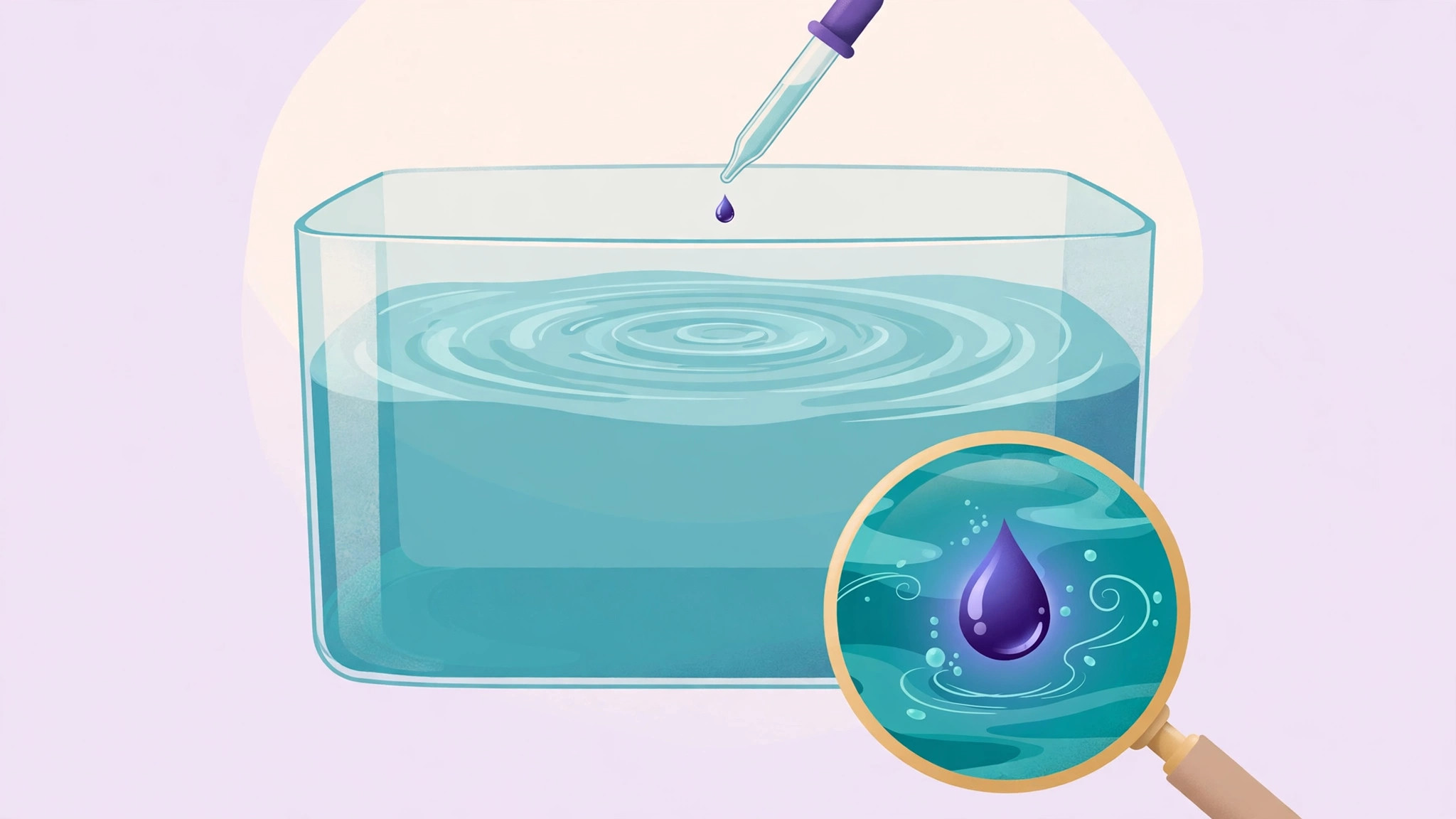
Percentages fail when the interesting amounts are tiny. One milligram of a substance in a litre of water is one part per million, written ppm, and one microgram per litre is one part per billion, ppb. The scale is hard to picture, so comparisons help: one ppm is roughly one drop of ink in a large bath of water, or one second in eleven and a half days. One ppb is one second in about thirty two years. These are the natural units of environmental chemistry, where lead in drinking water, pesticide residues on food and pollutants in air all live at trace levels that percentages would write as long strings of zeros.
Converting and measuring
For dilute water solutions, ppm and milligrams per litre are interchangeable, because a litre of water has a mass of almost exactly one kilogram. Percent converts by a factor of ten thousand: one percent is ten thousand ppm, so a 0.05 percent contaminant is 500 ppm. The concentration converter on the tools page handles these moves. Measuring at these levels needs instruments, not titrations: spectrometers and mass spectrometers detect specific atoms and molecules at ppb and below, and the history of environmental protection is largely a history of detection limits falling, revealing contamination that was always there but previously invisible.
Why small numbers still matter
It is tempting to dismiss a few parts per billion as nothing, but biology concentrates traces. Mercury climbs food chains, multiplying its concentration at each step, so water at ppb levels produces fish at ppm levels. Some substances are potent at trace doses by design: hormones signal in parts per trillion. Regulations are therefore written in these units, with limits like 10 ppb for arsenic in drinking water in many jurisdictions. Reading such numbers fluently, and knowing that ppm is a mass ratio that needs no units to cancel, is a genuinely useful piece of chemical literacy for any citizen reading a water quality report. A note on honesty in these units: ppm can be quoted by mass or by volume, and for gases in air the volume basis is usual, while for water the mass basis and milligrams per litre coincide. Confusion between the two has caused real reporting errors, so careful documents state the basis. For the dissolved substances in water that dominate school and citizen science, the simple equivalences in this guide hold, and the converter's answers are the right ones. When a figure matters for health or law, read the method note beside it; the unit is a ratio, and the ratio's terms deserve to be named.
Try it yourself
The calculator that goes with this guide is ready on the tools page.
Convert percent and ppm