Solubility Rules: What Dissolves and What Falls Out
Solubility rules predict which ionic compounds dissolve in water and which form precipitates. The short list worth learning and how it is used.
Rules of thumb that mostly hold
Whether an ionic compound dissolves is decided by a tug of war between the attraction of its ions for each other and their attraction to water. The solubility rules summarise thousands of experiments into a short list. All nitrates dissolve. All salts of group 1 metals and of ammonium dissolve. Most chlorides dissolve except those of silver and lead. Most sulfates dissolve except those of barium, lead and, partly, calcium. Most carbonates, phosphates and hydroxides do not dissolve, except when paired with group 1 metals or ammonium. Learned in that order, with the exceptions attached, the rules predict the outcome of nearly every mixing question in school chemistry.
Precipitation reactions
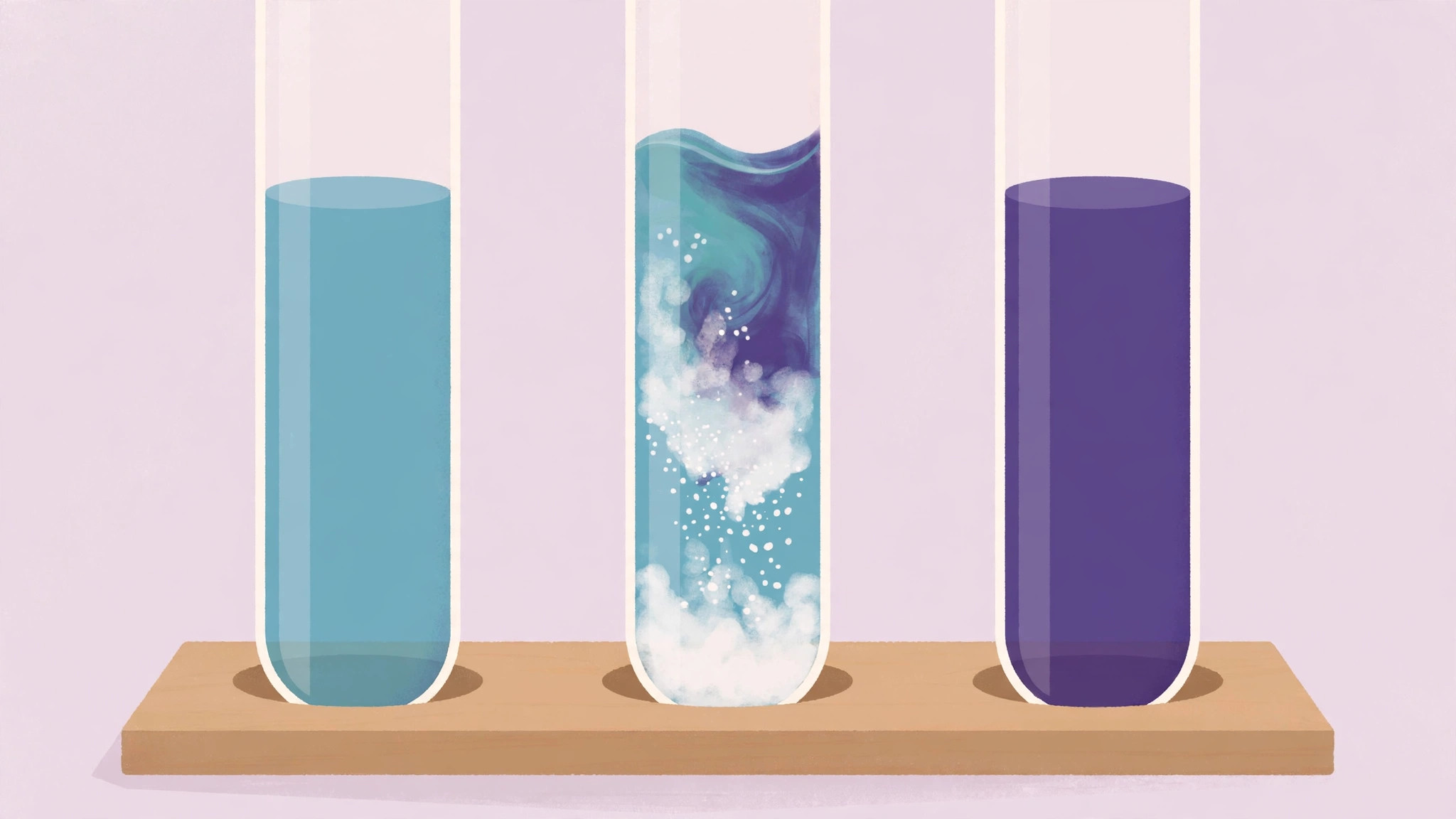
When two solutions are mixed and an insoluble compound can form from their ions, it does so at once, appearing as a cloudy solid called a precipitate. Silver nitrate added to sodium chloride throws down white silver chloride instantly, a reaction once used to test for chloride and to make photographic emulsions. Writing the ionic equation, which shows only the ions that actually combine, strips the event to its essence: Ag+ + Cl- gives AgCl, while the sodium and nitrate ions watch unchanged as spectators. The same logic purifies water, removes heavy metals from waste, and forms kidney stones when the body's own solutions grow too concentrated.
Using the rules in analysis
Qualitative analysis, the classical art of identifying unknown ions, is built from these rules applied in sequence: a precipitate with one reagent, dissolving in acid, a flame colour, each test narrowing the possibilities. Barium chloride tests for sulfate because barium sulfate is one of the most insoluble substances known, so insoluble that barium meals can be swallowed safely for X ray imaging despite soluble barium compounds being poisonous. The rules are empirical, with honest exceptions at the edges, but as a first prediction of what a mixture will do, they are among the most useful memorised facts in the subject. Temperature bends the rules in one direction often enough to be useful. Most solids dissolve better in hot water, which is the basis of recrystallisation, but a few, like calcium hydroxide, dissolve less as the water warms, and gases always dissolve less in warm water. The solubility rules as usually stated describe room temperature behaviour, and a precipitate that forms on cooling a hot saturated solution is not breaking them but obeying the temperature clause written in invisible ink beneath them. Kettles furring with limescale in hard water areas are calcium carbonate obeying exactly this clause, depositing as the water is heated.
Try it yourself
The calculator that goes with this guide is ready on the tools page.
Relate it to solution tools