Solutions and Mixtures: Dissolving at the Particle Level
A solution is a mixture where one substance dissolves completely in another. Solutions, suspensions and colloids compared, and what dissolving really does.
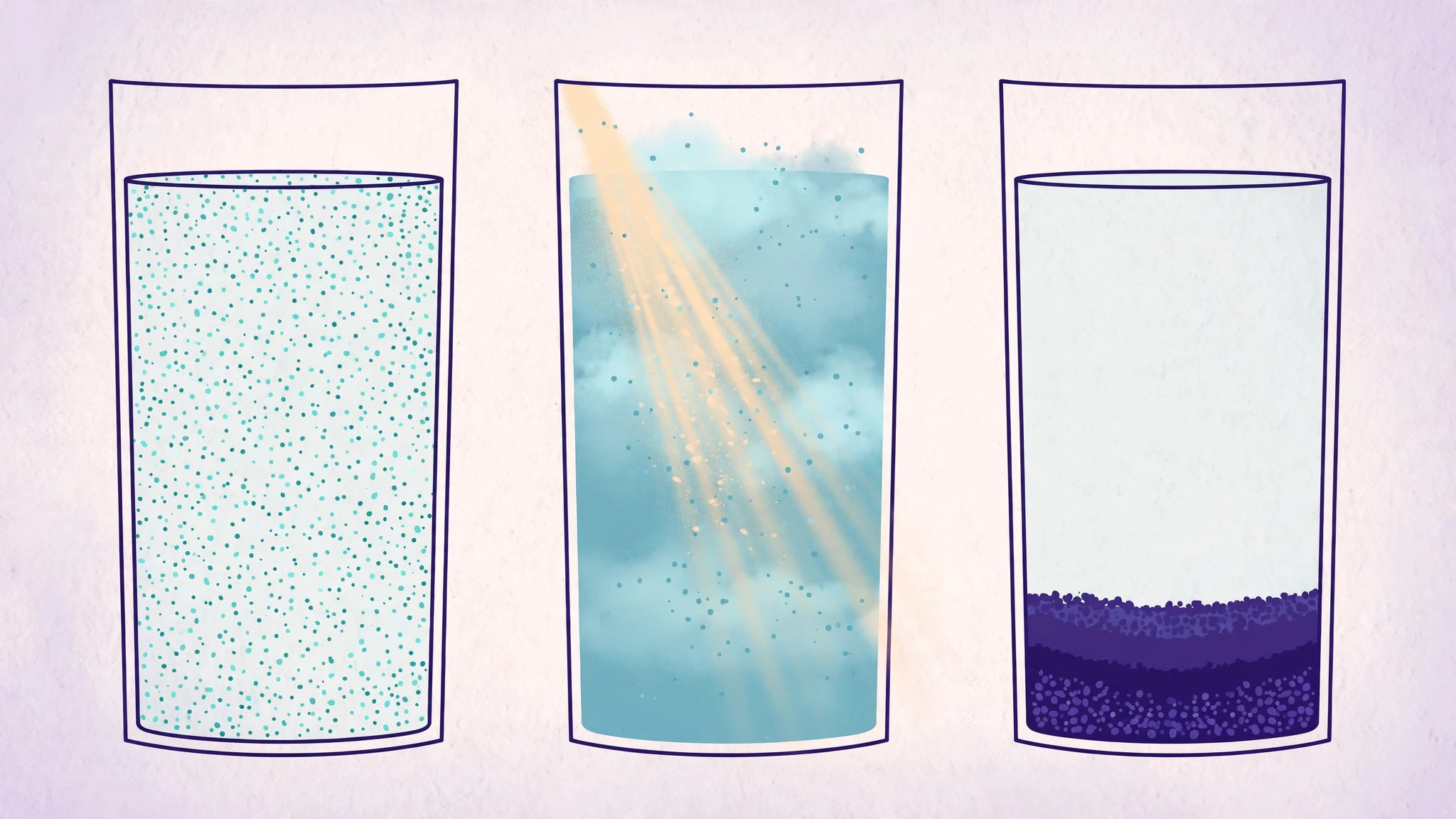
Dissolving is mixing at the particle level
When salt disappears into water it has not vanished or melted; its ions have been pulled apart and surrounded by water molecules, spread evenly through the liquid at the particle level. That evenness defines a solution: a homogeneous mixture whose composition is the same at every point, which never settles out and cannot be filtered apart. The dissolved substance is the solute, the liquid doing the dissolving is the solvent, and water's talent for the role, dissolving more substances than any other common liquid, earns it the title of the universal solvent, with the polar nature of its molecules doing the work on ionic and polar solutes.
Suspensions, colloids and the in between
Mixtures come in grades of fineness. A suspension, like muddy water or shaken flour, has particles large enough to see, to block light and to settle out on standing, and it can be separated by ordinary filtering. A colloid sits between: its particles, far larger than molecules but too small to settle, scatter light in the Tyndall effect, which is why a sunbeam shows in dusty air and headlights bloom in fog. Milk, fog, blood and paint are colloids, and their stability, neither dissolving nor settling, is a whole technology in food, medicine and materials. Knowing which grade a mixture belongs to predicts whether it will separate, filter, or hold.
Saturation and solubility
A solvent accepts solute only up to a limit at a given temperature, the solubility, beyond which the solution is saturated and extra solid rests undissolved in balance with the solution. Most solids grow more soluble as temperature rises, sometimes dramatically, which is how recrystallisation purifies compounds: dissolve in hot solvent, cool, and the pure substance crystallises out while impurities stay behind. Gases run the other way, dissolving less as water warms, which is why warm fizzy drinks go flat and why thermal pollution stresses fish. Concentration, the subject of half the tools on this site, is simply the measure of how close to that limit a given solution sits. One more idea ties the topic to the rest of the site: a solution's properties depend on how many particles are dissolved, not only on how much mass. A mole of glucose and a mole of sodium chloride in the same volume of water lower the freezing point differently, because the salt separates into two ions and delivers twice the particles. Properties that count particles in this way are called colligative, and they explain everything from salt on icy roads to the osmotic pressure that moves water across cell membranes. Whenever a solution behaves as if it contains more than you dissolved, count the particles again; they have usually multiplied by dissociating.
Try it yourself
The calculator that goes with this guide is ready on the tools page.
Measure a solution's strength