Specific Heat: The Price of Warming Up
Specific heat is the energy needed to warm one gram of a substance by one degree. Why water's value is so high, and how q = mc delta T is used.
The price of a degree
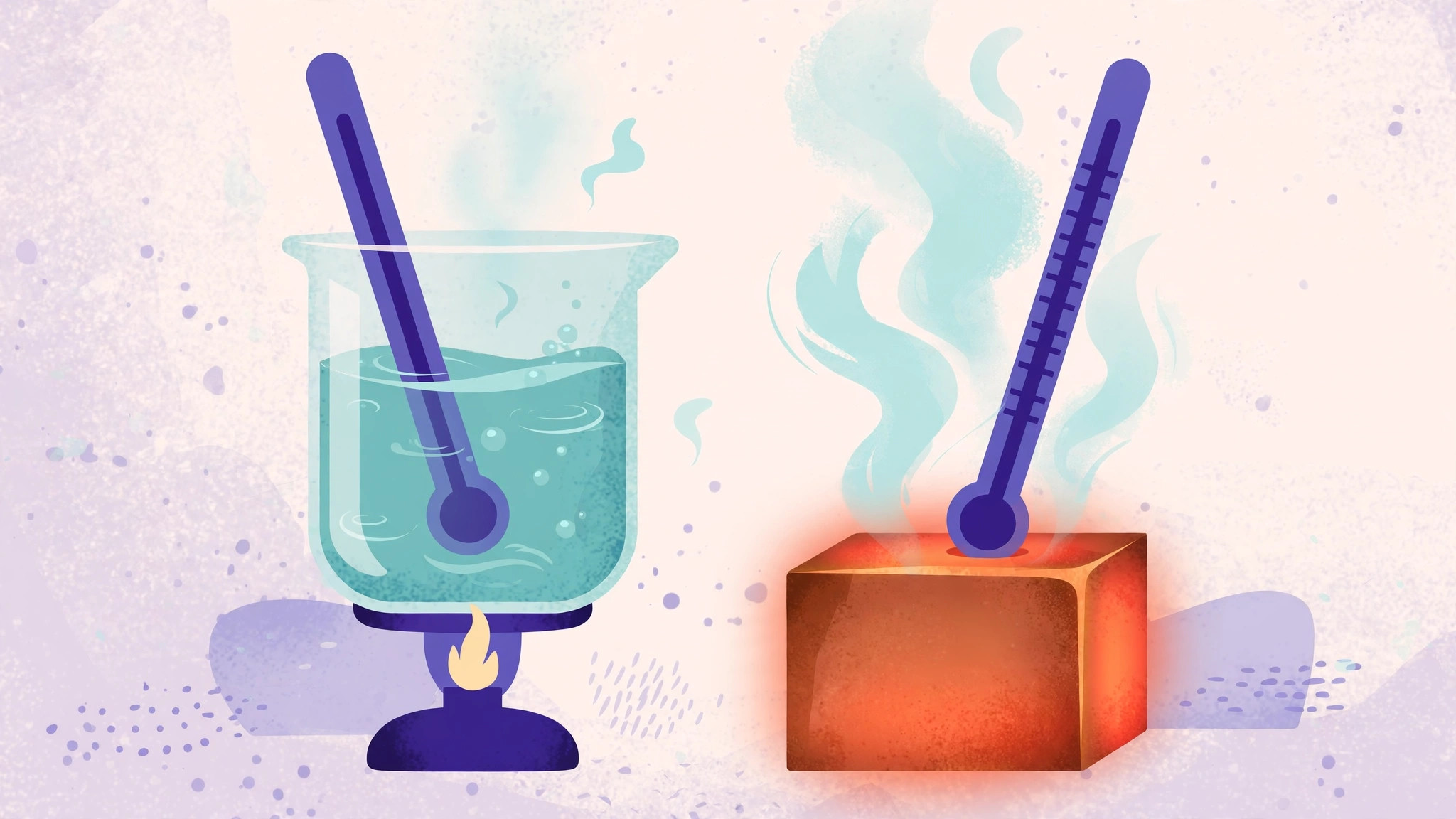
Every substance charges its own price, in energy, for each degree of warming. That price is its specific heat capacity: the joules needed to raise one gram by one degree Celsius. Water charges 4.184 joules, one of the highest prices among common substances, while copper asks only 0.385 and ice about 2.09. The governing equation is q = mc delta T, heat equals mass times specific heat times temperature change, and it rearranges to find any one of the four quantities from the other three, which is what the specific heat calculator on the tools page does with one field left blank.
Why water is the great moderator
Water's high specific heat comes from its hydrogen bonds, which absorb energy by bending and breaking before the molecules speed up. The consequences shape the planet: oceans store summer heat and release it slowly, softening coastal climates, while dry land, with the low specific heat of rock and sand, swings between hot days and cold nights. The same property makes water the default coolant in engines and power stations and the standard substance of the calorimeter, the insulated vessel in which reaction energies are measured by watching water warm up.
Calorimetry in practice
To measure the energy of a reaction or a food, burn it or run it inside a calorimeter and record the water's temperature rise. Fifty grams of water warmed by 12 degrees has absorbed 50 x 4.184 x 12, about 2,510 joules, and that figure, corrected for losses, is the energy the process released. School experiments with spirit burners heating cans of water follow exactly this pattern and usually under-read, because heat escapes to the air and the can. Noticing where the missing joules went is not a failure of the experiment; it is the experiment's most instructive result. The value for water also explains a piece of laboratory furniture: the water bath. A substance that is hard to heat is equally hard to cool, so a large water bath holds its temperature steady against the disturbances of a busy bench, protecting temperature sensitive reactions from drift. Phase change extends the same protection further, since ice melting at zero degrees absorbs large amounts of heat without warming at all. Between its high specific heat and its latent heats, water is the great stabiliser of temperature in the laboratory, in the climate and in the body, whose own temperature regulation leans on both properties every minute of the day.
Try it yourself
The calculator that goes with this guide is ready on the tools page.
Open the specific heat calculator