Strong and Weak Acids: Strength Is Not Concentration
Strong acids ionise completely in water while weak acids only partly ionise. What the difference means for pH, conductivity and safe handling.
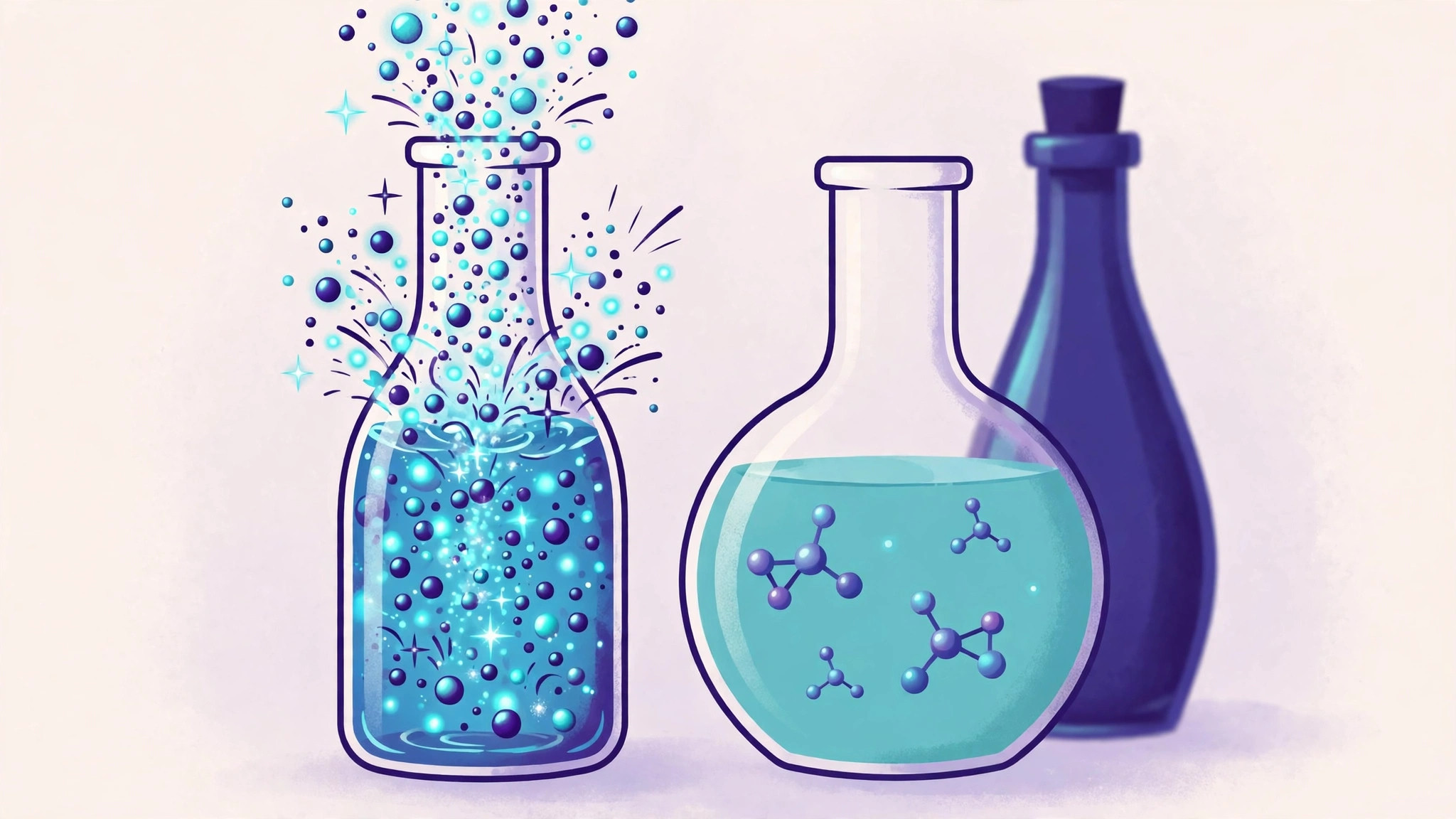
Complete versus partial ionisation
An acid produces hydrogen ions when it dissolves, and acids divide sharply by how completely they do it. A strong acid, such as hydrochloric, nitric or sulfuric acid, ionises essentially completely: every molecule gives up its hydrogen ion, so the hydrogen ion concentration equals the acid concentration. A weak acid, such as ethanoic acid in vinegar or carbonic acid in fizzy drinks, ionises only slightly, often with fewer than one molecule in a hundred ionised at any moment. The rest stay as whole molecules, in a balance called an equilibrium, which is why weak acids behave so differently at the same concentration.
Strength is not concentration
The common confusion is between a strong acid and a concentrated one. Strength describes the fraction that ionises; concentration describes how much acid is present per litre. A dilute strong acid can be far less acidic in effect than a concentrated weak one, and a 0.01 molar strong acid has a pH of 2 while a 0.01 molar weak acid might sit near pH 3.4, because only part of it has ionised. Calculating the pH of a strong acid is therefore easy, a single logarithm, while a weak acid needs its acid dissociation constant and an equilibrium calculation.
Everyday signs of the difference
Weak acids dominate kitchens and biology precisely because their restraint makes them manageable: vinegar, citric acid in fruit, and the carbonic acid that buffers blood. Strong acids are industrial tools, used for cleaning metals, making fertilisers and processing ores, and they demand respect in handling because a concentrated strong acid releases its hydrogen ions all at once on contact with water or tissue. Conductivity tells the two apart in the laboratory: at equal concentration the strong acid conducts far better, because it fills the solution with ions, while the weak acid leaves most of its molecules electrically silent. The same distinction runs through the bases. Sodium hydroxide is a strong base, fully ionised in solution, while ammonia is a weak base that produces hydroxide ions only sparingly, by taking hydrogen ions from water. Cleaning products exploit both ends of the range: caustic oven cleaners are strong and concentrated, while the ammonia in glass cleaner is weak and dilute enough for household use. The labels strong and weak, like concentrated and dilute, describe separate axes, and careful hands in the laboratory keep the two apart in thought as carefully as the bottles are kept apart in storage.
Try it yourself
The calculator that goes with this guide is ready on the tools page.
Calculate a strong acid pH