Temperature Scales: Celsius, Fahrenheit and Kelvin
Celsius, Fahrenheit and kelvin measure the same thing on three different rulers. Where each scale came from, and why chemistry insists on kelvin.
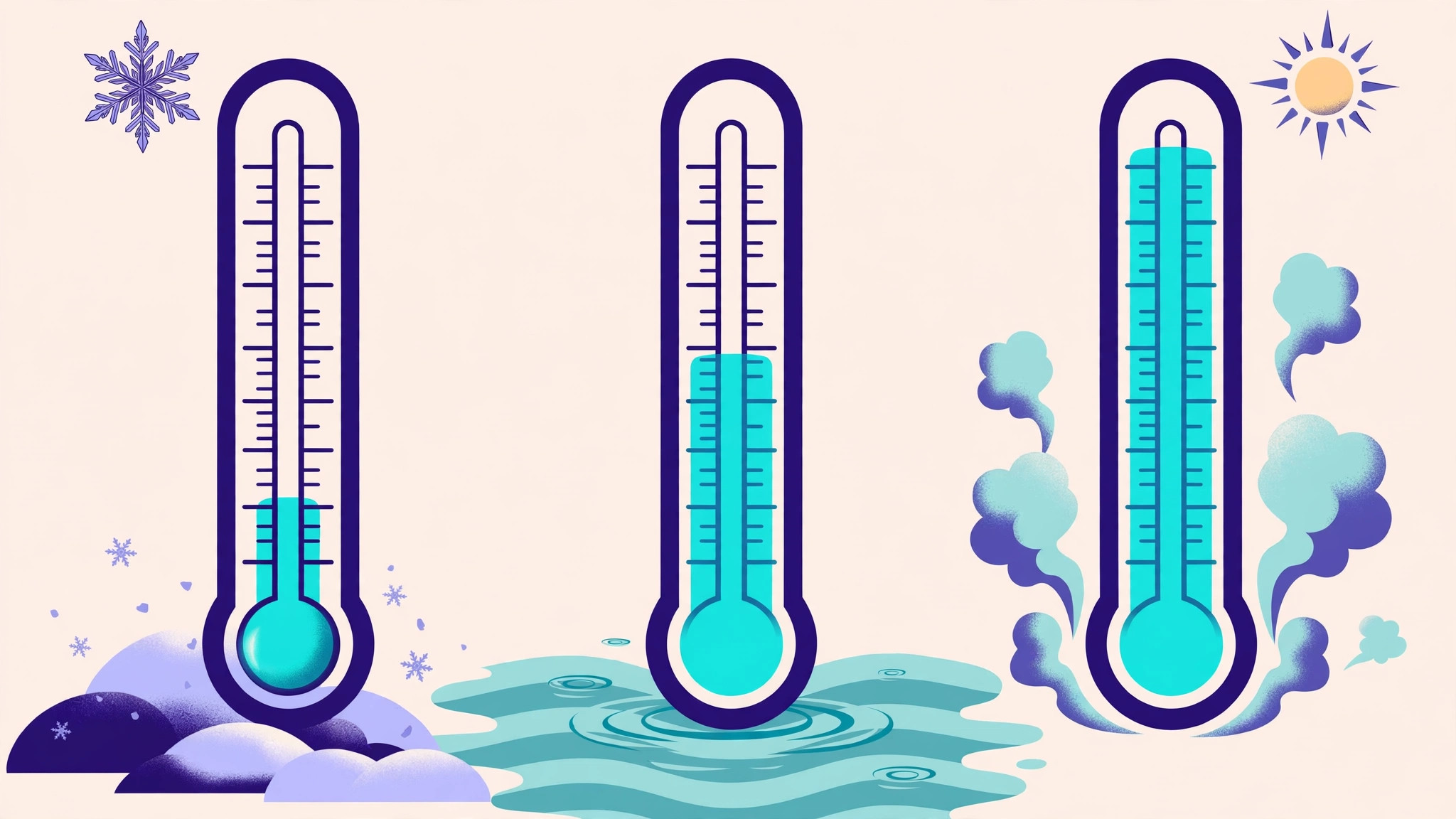
Three rulers for one quantity
Temperature scales are human inventions laid over one physical reality, the average kinetic energy of particles. Celsius sets its zero at the freezing point of water and 100 at boiling, a tidy hundred steps. Fahrenheit, older, set its points by the coldest mixture its inventor could make and by body heat, landing water's freezing at 32 and boiling at 212. Kelvin starts at the true bottom, absolute zero, the point where particle motion reaches its minimum, and uses Celsius sized steps, so water freezes at 273.15 kelvin and boils at 373.15. Converting is arithmetic: add or subtract 273.15 between Celsius and kelvin, and use the nine fifths rule for Fahrenheit.
Why gas laws demand kelvin
Ratios are the reason chemistry is strict about kelvin. Doubling a Celsius temperature from 10 to 20 degrees does not double anything physical, because the scale starts at an arbitrary point. Doubling 283 to 566 kelvin does double the average particle energy, and gas volumes and pressures respond to the true ratio. Any formula that multiplies or divides by temperature, which is every gas law and much of thermodynamics, therefore requires the absolute scale. The temperature converter on the tools page shows all three scales at once, a useful habit to copy in written work: state the kelvin value beside the Celsius one whenever a gas calculation is coming.
Absolute zero and beyond the ordinary
Kelvin has no negative values, because there is nothing below the minimum energy state for temperature to measure. Laboratory physics has approached absolute zero to within billionths of a degree, finding matter behaving strangely, forming condensates where atoms move as one. At the other end, the kelvin scale runs unbroken to the cores of stars at tens of millions of degrees, needing no rescaling. For everyday life Celsius and Fahrenheit serve their regions well, but kelvin is the scale the universe keeps its own books in, and meeting it early makes later physics feel familiar rather than foreign. Everyday anchors make the three scales easy to hold together. Room temperature is about 20 degrees Celsius, 68 Fahrenheit, 293 kelvin. Body temperature is 37 Celsius, 98.6 Fahrenheit, 310 kelvin. A hot oven is 200 Celsius, about 400 Fahrenheit, 473 kelvin. Liquid nitrogen boils at 77 kelvin, which is minus 196 Celsius, a figure that shows how far the absolute scale reaches into cold that the other scales describe with large negative numbers. Keeping two or three anchors memorised lets you estimate any conversion before checking it, and an estimate that disagrees with a calculator is the fastest error detector there is.
Try it yourself
The calculator that goes with this guide is ready on the tools page.
Open the temperature converter